← Back to Blog
How to Calculate Revenue Per Stall at Your Boarding Barn

How to Calculate Revenue Per Stall at Your Boarding Barn

Stables
Horse Barn Management SoftwareHorse Stall Management Software | Guides & Best Practices

Revenue per stall is not a sophisticated financial metric. It's a simple calculation that most boarding barn operators have never made, and when they make it for the first time, it almost always changes how they think about their operation.

Here's the calculation: take your total monthly revenue and divide it by the number of occupied stalls. That's your revenue per stall.

If you're billing $750 for board and nothing else, revenue per stall equals your board rate. But most barns aren't collecting just the base board rate from every stall. Some horses have blanketing services. Some owners pay for extra feedings. Some stalls are attached to training programs. When you calculate revenue per stall with all of that included, the number is almost always different from your base boarding rate.

Why This Number Matters More Than Occupancy

Barn operators track occupancy because it's the easiest metric to see. Occupancy is useful. It's just not sufficient.

A barn at 95% occupancy with revenue per stall of $720 is generating less revenue than a barn at 85% occupancy with revenue per stall of $850. The stall with the training add-on package, the blanketing service, and the premium full-care board is worth more than a vanilla board stall, even at a lower occupancy rate.

Revenue per stall forces you to think about the mix of your operation rather than just the headcount. If your highest-margin stalls are the ones with training add-ons, that's information that should influence whether you expand your training program.

Calculating Revenue Per Stall by Stall Type

The aggregate calculation is a starting point. The more useful calculation breaks revenue down by stall type.

Full-care stalls: Base board rate plus all services attached. For a $750 base rate with an average of $120 in attached services, the full-care revenue per stall is $870.

Pasture board stalls: Base rate only in most cases, though some pasture board arrangements include supplemental feeding. Calculate the actual average.

Training board stalls: These are often your highest revenue per stall. Base board plus training fees can push a single stall to $1,500 or more per month. They also often carry the highest direct costs, so the margin calculation matters as much as the revenue figure.

Inactive stalls: These show up in your stall count but generate no revenue. Track them separately to understand your effective revenue capacity.

The Connection to Expense Per Stall

Revenue per stall becomes most useful when you pair it with expense per stall: your total operating expenses divided by occupied stalls. This is your break-even floor.

If your expense per stall is $520 per month and your revenue per stall is $750, you have a $230 per-stall margin at 30.7% net. If your revenue per stall is $750 and your expense per stall is $680, your margin is $70 per stall. At 40 stalls, you're generating $2,800 per month in net income from a $30,000 revenue operation at 9.3% margin, thin enough that any disruption turns profitable months into loss months.

How to Track This Without a Spreadsheet Crisis

The manual version of this calculation requires pulling together your board invoices, your add-on charges, your total occupied stall count, and your monthly expense data. Doing it once is valuable even if you never do it again.

The sustainable version tracks it automatically. When every board payment, every service add-on, and every expense runs through one system, revenue per stall calculates itself.

This is part of what the Stables platform delivers. Revenue per stall is one of the core metrics in the Barn P&L dashboard, calculated from actual transaction data.

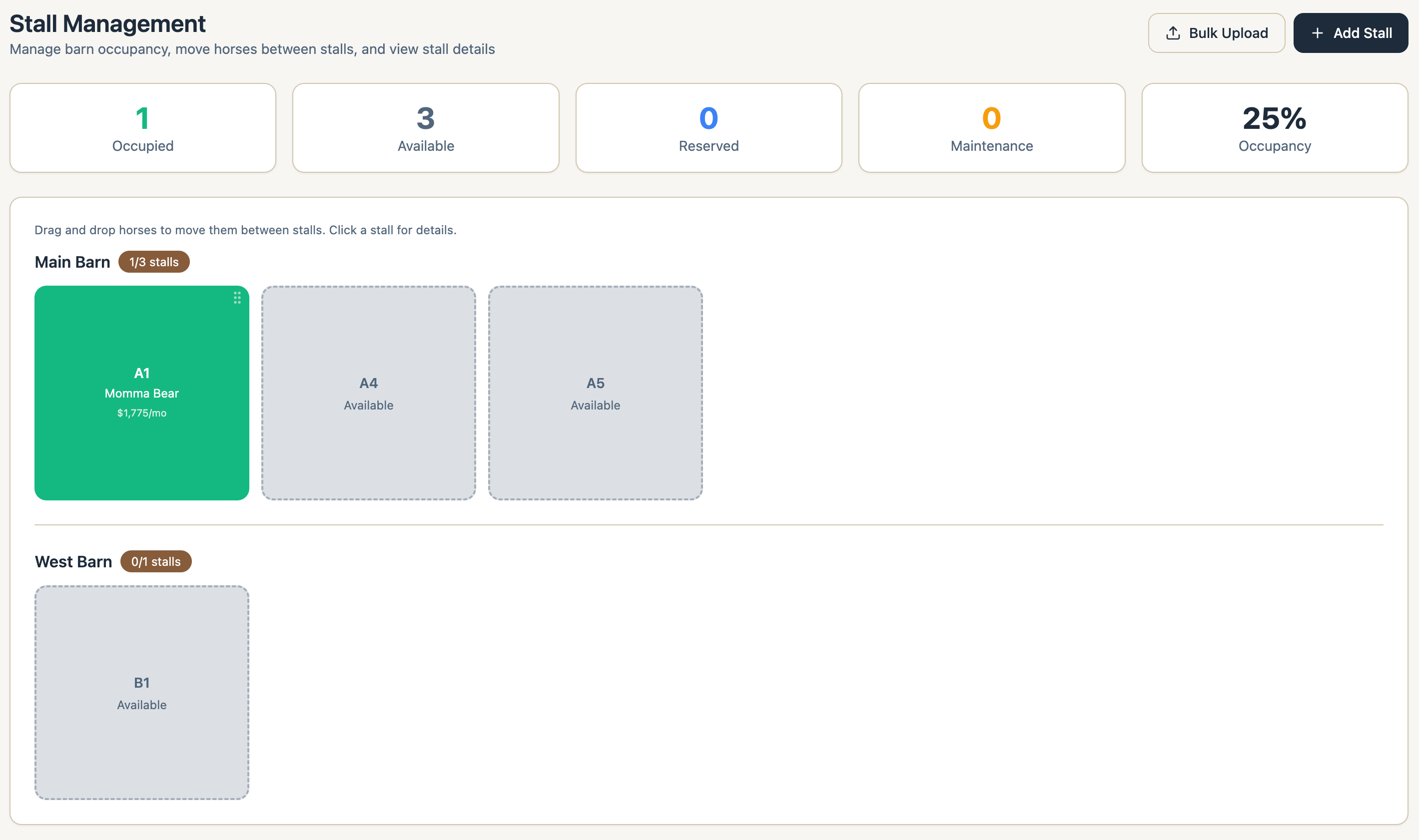
Stall management software handles the headcount side. The financial layer handles the revenue side. You need both to see the full picture.

Related Reading

- Is Your Horse Boarding Barn Actually Profitable?

- The Complete Guide to Building a Horse Boarding Barn P&L

- Horse Stall Management Software

WEEK 5: Why Manual Horse Boarding Invoicing Is Costing You More Than You Think

URL: https://stables.co/blog/manual-horse-boarding-invoicing-problems

Category: horse-boarding-invoicing-and-billing

Primary Keyword: horse boarding invoicing problems

Meta Description: Manual invoicing isn't just tedious. It creates late payments, billing errors, and cash flow gaps that compound month over month. Here's the real cost of doing it the old way.

There's a version of manual invoicing that feels fine: you send the invoices at the start of the month, most people pay within a week or two, and the operation keeps moving. It's imperfect but it works.

That version of the story hides what's actually happening underneath. Manual invoicing creates a specific set of conditions that compound over time into delayed payments, billing errors, collection conversations, and administrative overhead that quietly consumes your time and damages your margins.

The Error Rate Problem

Manual invoicing introduces errors. Not because you're careless. Because the process is error-prone by design.

When you're building invoices in a spreadsheet or Word document, you're re-entering information that already exists somewhere else: the board rate, the services attached to each horse, the add-ons that were added or removed mid-month. Every re-entry is an opportunity for a mismatch between what you meant to charge and what you actually charged.

Common errors include: the wrong board rate applied because you updated rates for some boarders but not all; an add-on service that was added mid-month and didn't make it onto the invoice; a credit from last month's overpayment that wasn't applied.

Boarding facilities using manual invoicing typically have an error rate between 3% and 8% per billing cycle. At 40 stalls, that's one to three invoices with some kind of issue every single month.

The Timing Problem

Manual invoicing sends payments later than they need to be.

If you invoice on the 1st, some boarders receive the invoice and pay within two or three days. Others set it aside. Others forget. The natural distribution of payment timing means a meaningful percentage of payments arrive in the second or third week of the month even when the due date is the 1st.

The gap between your due date and your average collection date is your cash float: money you've earned but don't have yet. In a 40-stall operation at $750 per stall, a 10-day average collection lag means you're floating roughly $10,000 in earned revenue at any given time.

Automated invoicing with card-on-file or ACH collection collapses this lag from 10 to 15 days to 1 to 2 days. The math on what that does to your cash position compounds significantly over a year.

The Follow-Up Labor Problem

Every invoice that doesn't get paid on time generates follow-up work. Map the actual labor for a single late payment: notice the invoice hasn't been paid by day 7, send a reminder email, check back in three days, send a text, boarder says they'll handle it, check back two days later. Four to six individual communications spanning two weeks for a single late payment.

Automated billing with payment reminders, retry logic on failed payments, and real-time collection tracking eliminates most of this labor. When the system handles the follow-up automatically, your involvement becomes the exception rather than the routine.

The Consistency Problem

Manual invoicing is only as consistent as the person doing it on the day they're doing it. On a busy week, invoices go out late. During the holidays, timing shifts. Each inconsistency trains boarders that your billing schedule is approximate, which trains them that their payment timing can be approximate as well.

Consistency in billing creates consistency in payment. Boarders who receive their invoice on the same day every month develop predictable payment habits.

The Real Conversation to Have

The question isn't whether to fix manual invoicing. It's whether the cost of fixing it is worth the cost of keeping it.

For a 20-stall operation or larger, the error rate, float cost, and labor overhead of manual invoicing almost always exceeds the cost of automation significantly.

Read about common billing mistakes boarding barns make and how automated invoicing changes the collection picture. Stables was built specifically for this problem, and the boarding barn software ROI article walks through the actual math on what the switch is worth financially.

Related Reading

- How to Automate Horse Boarding Invoices

- Common Horse Boarding Barn Billing Mistakes

- The Real Cost of a Late Board Payment