How to Automate Horse Boarding Invoices at Your Barn (Step-by-Step Guide)
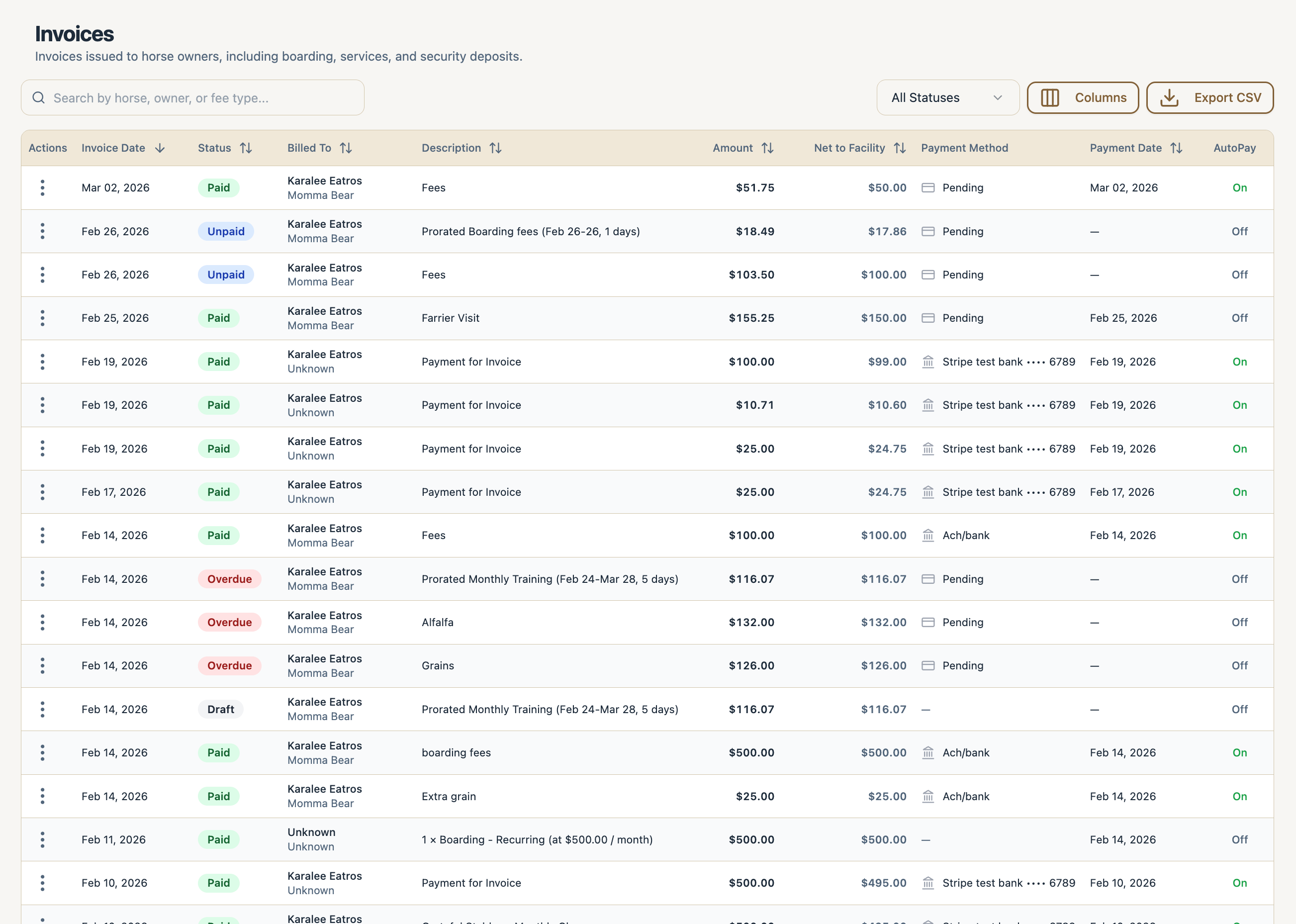
If you run a horse boarding facility, automating horse boarding invoices is the single highest-ROI change you can make to your billing operation.
When you automate boarding invoices, you stop chasing payments, eliminate manual errors, and turn billing into a predictable, systemized revenue engine.
This guide walks you through:
- Why manual invoicing leaks revenue
- How to set up recurring billing correctly
- How to handle proration math
- How to configure auto-pay
- How to integrate care-to-cash
- How to build an AR dashboard that protects cash flow
If you’re still using spreadsheets, paper checks, Venmo, or QuickBooks alone for board billing, this will materially change your margins.
Why Manual Horse Boarding Invoicing Leaks Revenue
Manual billing systems create structural revenue leakage.
Here’s where barns lose money:
1. Missed Add-On Charges
- Extra grain
- Blanketing
- Holding for vet/farrier
- Medication administration
- Late fees
If these are tracked on whiteboards or in text threads, they don’t always make it onto invoices.
Leak rate at small barns: typically 3–8% of monthly revenue.
2. Delayed Invoicing
If invoices go out late:
- Cash flow slows
- Owners push payments
- AR ages unnecessarily
3. Math Errors
Manual proration and mid-month changes create:
- Underbilling
- Awkward corrections
- Trust erosion
4. No Auto-Pay
Without saved payment methods:
- You become collections
- Staff spends hours following up
- Owners normalize late payments
Bottom line: Manual invoicing makes revenue optional.
Automating boarding invoices makes it systematic.
Step 1: Set Up Recurring Boarding Billing Correctly
Board is not a one-time charge. It’s infrastructure revenue.
To automate boarding invoices, you must convert board into structured recurring billing.
How to Structure It
For each horse:
- Base board price (e.g., $1,200/month)
- Billing cadence (monthly, semi-monthly)
- Billing date (e.g., 1st of each month)
- Assigned payer (owner or ownership group)
In modern horse management software, this becomes a recurring charge tied to the horse and the client profile.
Instead of recreating invoices every month, the system:
- Generates invoices automatically
- Applies tax rules if applicable
- Sends notifications
- Queues payment attempts
This eliminates 100% of repetitive admin.
If you’re evaluating tools, this is a core feature of dedicated horse management software platforms built for boarding facilities.
Step 2: Handle Proration Math Automatically
Proration is where most barns make mistakes.
Common scenarios:
- Horse arrives on the 18th
- Horse leaves mid-month
- Board increases mid-cycle
- Temporary rate adjustments
The Proration Formula
Standard daily proration model:
Monthly Board ÷ Days in Month × Days Occupied = Prorated Charge
Example:
- $1,200 monthly board
- 30-day month
- Horse arrives on day 18
- 13 days remaining
1200 ÷ 30 × 13 = $520
Manual calculation is fine once.
At scale? It breaks.
Your billing system should:
- Auto-calculate daily rate
- Apply prorated charge
- Merge with next full billing cycle
- Keep audit trail
If you can’t do this automatically, you will undercharge over time.
Step 3: Configure Auto-Pay (Non-Negotiable)
If you want to truly automate boarding invoices, auto-pay must be default - not optional.
Best Practice Auto-Pay Setup
- Require payment method on file before move-in
- Store securely via PCI-compliant processor
- Default to automatic charge on invoice due date
- Retry failed payments automatically
- Apply late fees programmatically
Why This Matters
Barns without auto-pay:
- Average 10-20% of invoices late
- Spend 5-10 admin hours per month on collections
- Experience avoidable cash flow volatility
Barns with enforced auto-pay:
- 95%+ on-time payments
- Predictable revenue cycles
- Zero collections texting
If your system still requires manual invoice payment, it’s not true automation.
Step 4: Integrate Care-to-Cash
This is where most facilities fail.
Board isn’t the only revenue source.
You likely charge for:
- Lessons
- Training rides
- Holding for vet/farrier
- Medication
- Grooming
- Special feed programs
If care events are tracked separately from billing, charges get lost.
Care-to-Cash Automation Model
- Staff logs a care event
- Event is linked to a pricing rule
- Charge is automatically created
- Charge flows into next invoice
- Auto-pay collects
No manual data re-entry.
This eliminates “Oh I forgot to bill that.”
Integrated systems connect operations and billing. Disconnected tools don’t.
This is why many barns outgrow generic accounting software and move to purpose-built horse boarding management software that unifies:
- Horses
- Care plans
- Staff assignments
- Invoicing
- Payments
When care drives billing automatically, revenue capture improves immediately.
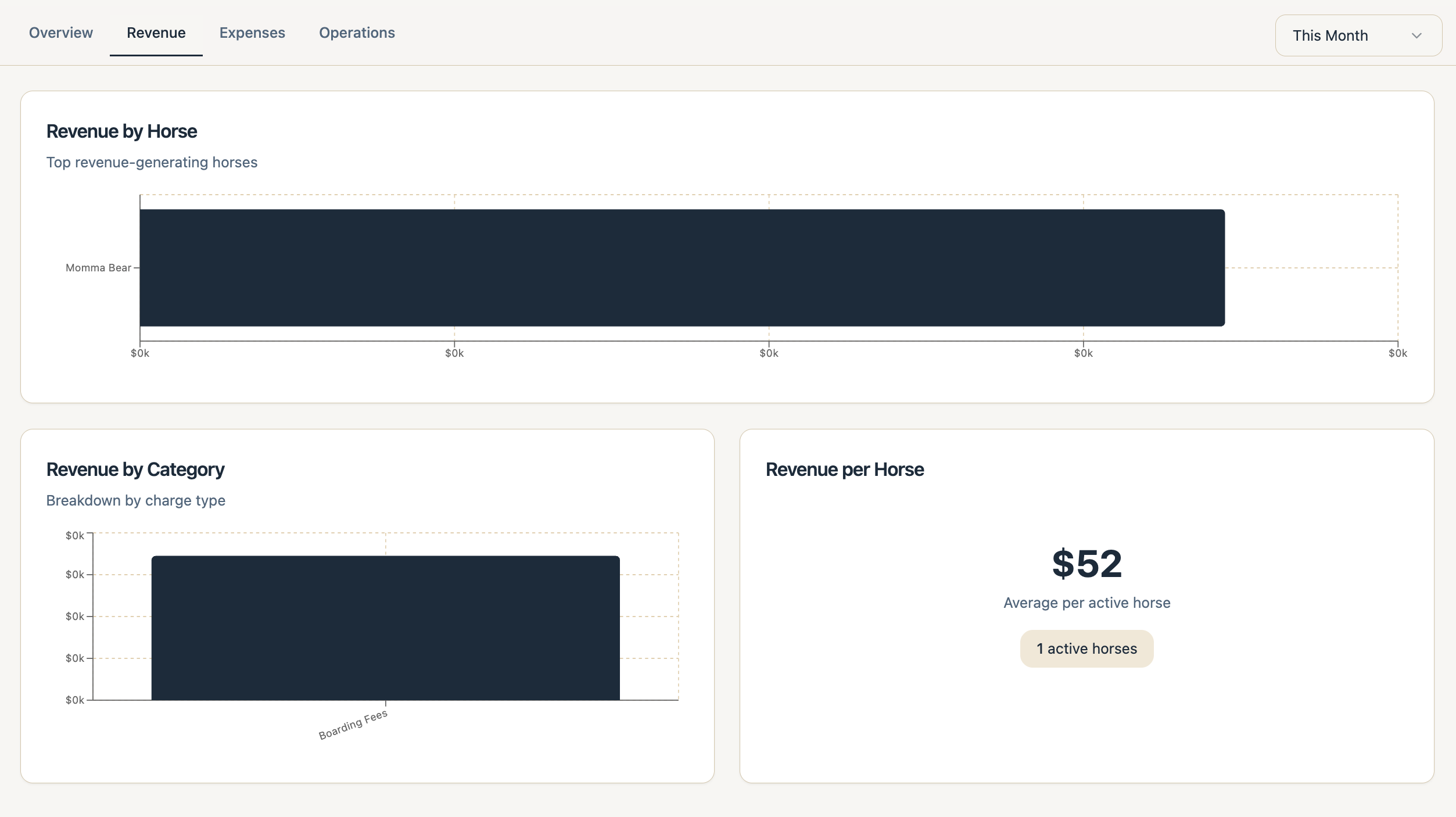
Step 5: Build an AR Dashboard That Protects Cash Flow
Automation is incomplete without visibility.
Your Accounts Receivable dashboard should show:
Core Metrics
- Total outstanding balance
- Current vs 30/60/90+ days
- Failed payment attempts
- Upcoming auto-charges
- MRR (monthly recurring revenue)
Best Practice Controls
- Daily failed-payment alerts
- One-click retry
- Auto late fee rules
- Aging summary by client
If you can’t see who owes you money in under 10 seconds, you don’t have financial control.
Automated billing without AR oversight still leaks revenue.
Implementation Checklist (Quick Start)
If you want to automate boarding invoices this month:
- Convert all board charges to recurring billing
- Enable mandatory payment methods on file
- Turn on auto-pay for all clients
- Configure automatic proration rules
- Connect care logging to billing
- Activate AR dashboard monitoring
- Eliminate manual invoice creation
Most barns can implement this in under two weeks with the right system.
The Financial Impact of Automating Horse Boarding Invoices
Typical results after automation:
- 3–8% revenue recovery from missed charges
- 90%+ reduction in billing admin time
- 95%+ on-time payments
- Improved owner transparency
- Reduced awkward billing conversations
At a 40-horse facility averaging $1,200/month:
40 × 1,200 = $48,000/month
Recovering just 5% leakage:
$2,400/month = $28,800/year
That’s from billing discipline alone.
Final Thought: Billing Is Infrastructure
Boarding revenue is the foundation of your business.
If billing is manual, fragile, or dependent on memory, your margins are exposed.
When you automate boarding invoices:
- Revenue becomes systematic
- Cash flow stabilizes
- Staff workload drops
- Owners gain clarity
If your current system can’t do this cleanly, it may be time to evaluate dedicated horse management software built specifically for boarding operations.
Because in a barn, missed charges aren’t small mistakes - they compound quietly.
See How Stables Automates Your Billing → Get Started Free
Explore how modern horse management software automates recurring board, proration, care-to-cash, and auto-pay in one unified system.
Your revenue deserves infrastructure.