Horse Boarding Billing Mistakes: How to Stop Missing Charges
Most boarding facilities are running a leaky bucket. Water goes in - services get delivered, horses get cared for - but money leaks out the bottom before it ever reaches an invoice. If you've ever ended a month wondering why revenue feels lower than it should, boarding barn billing mistakes are almost certainly the reason. Leveraging horse boarding software can help reduce mistakes and increate profit.
The Revenue You're Already Earning - But Not Collecting
Here's an uncomfortable question: how confident are you that every service your team delivered last month made it onto a client invoice?
Not mostly confident. Completely confident.
For the vast majority of boarding facilities, the honest answer is: not very. Industry estimates suggest that small-to-mid-size boarding operations miss between 10% and 20% of billable charges every single month - not because of fraud, not because of laziness, but because of a fundamentally broken workflow that relies on human memory to bridge the gap between care delivery and billing.
On a facility grossing $15,000 per month, that's $1,500 to $3,000 in services rendered but never invoiced. Over a year: $18,000 to $36,000 gone. Not lost to overhead. Not lost to market competition. Lost because someone forgot to write it down - or wrote it down and the note never made it to QuickBooks.
Understanding where that money disappears requires mapping the journey every charge takes from the moment a service happens to the moment a payment clears. That journey is longer and more failure-prone than most barn owners realize. Leveraging an equine billing software like Stables can help prevent all of this.
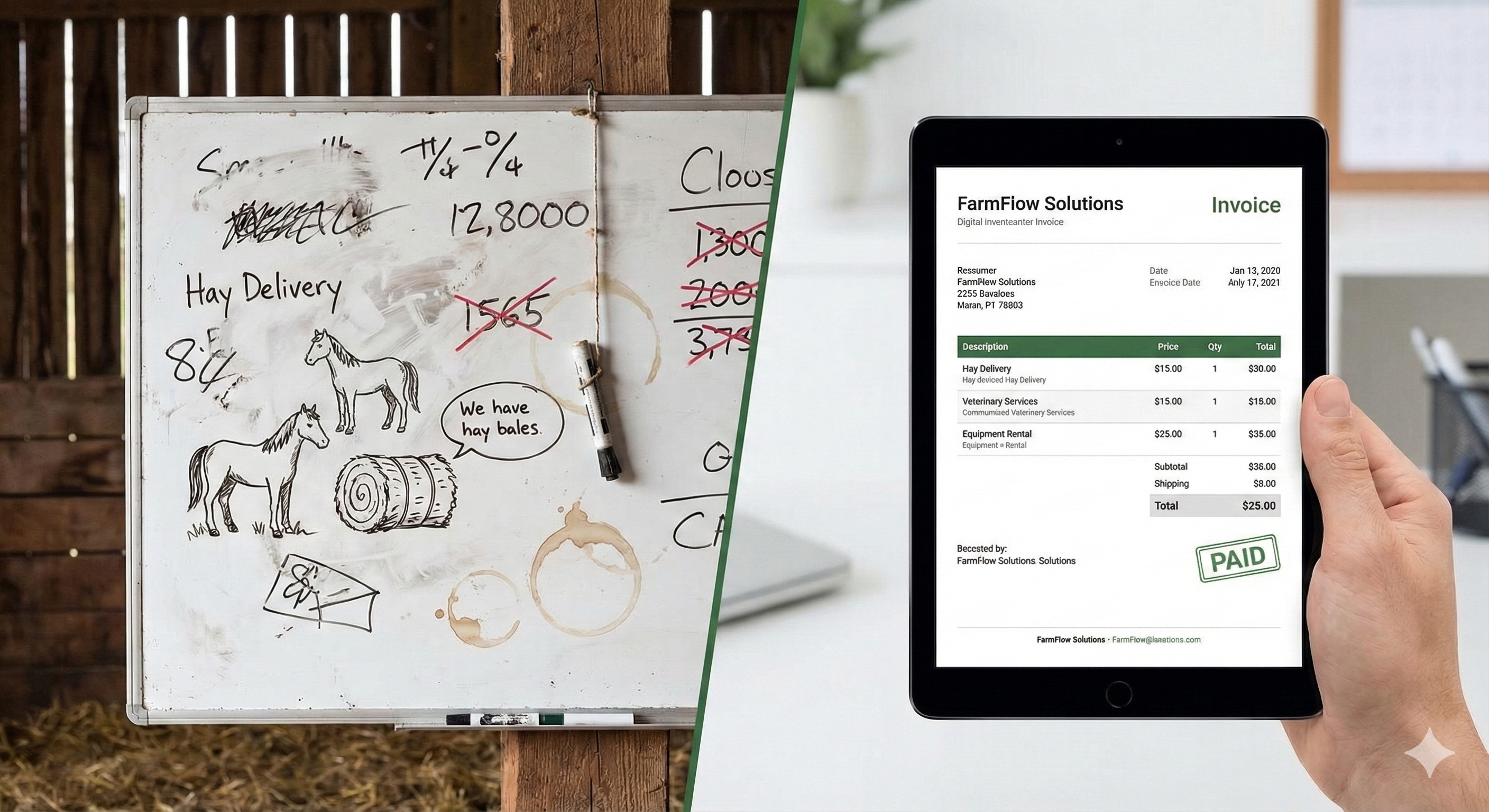
The Whiteboard-to-Invoice Pipeline: Where Charges Go to Die
Most boarding facilities run on a version of the same informal system. A care event happens - the farrier comes out, a horse gets a blanket pulled, extra grain gets added, a vet visit is assisted - and someone records it. Maybe on a whiteboard in the feed room. Maybe in a spiral notebook. Maybe in a text message to themselves.
At the end of the month, someone - usually the barn owner or office manager - tries to reconstruct billing by collating those scattered notes into invoices. Here's what that pipeline actually looks like, and where it breaks:
Failure Point 1: The Unrecorded Event
The team is busy. A horse gets a quick dose of electrolytes. Someone tosses an extra flake of hay because a horse looked off. A farrier pulls a loose shoe on an emergency call. These micro-services happen dozens of times a month, and the mental math of "I'll write that down later" is almost always wrong. Later never comes. The charge evaporates.
Failure Point 2: The Illegible or Incomplete Note
Even when something gets recorded, barn notes are notorious for being incomplete. "Extra hay - Bella" doesn't tell you how much hay, what date, or what the facility charges per flake. By the time billing rolls around, that note is unactionable and gets skipped.
Failure Point 3: The Transfer Gap
Notes on the whiteboard have to become a line item in a billing document. That transfer - from physical record to invoice - is a manual, error-prone process. Pages get missed. Notes from two different staff members don't get reconciled. The farrier's visit gets invoiced; the additional labor to hold the horse doesn't.
Failure Point 4: The Memory Tax at Month-End
Billing at the end of the month means billing from memory for anything that wasn't properly documented. The longer the lag between service delivery and invoice creation, the higher the memory tax - and the more charges get left behind.
Failure Point 5: No Audit Trail
When a client disputes a charge or asks what the $45 fee is for, barn owners who rely on informal systems often can't answer with confidence. Without a timestamped, documented record of what happened, charges get quietly removed to avoid conflict. That's not a client relations win - it's a revenue leak disguised as hospitality.
Quantifying the Damage: What Boarding Barn Billing Mistakes Actually Cost
Let's make this concrete. Below is a typical missed-charge audit for a 30-horse boarding facility over a single month:
Service Category - Avg. Incidents
Blanketing / Unblanketing - 18
Extra grain / supplements - 22
Emergency farrier calls - 4
Vet assist / barn time - 3
Extra turnout / stall rest - 8
Medication administration - 12
TOTAL Lost Revenue ~$313/month
That's $3,756 per year — on a single 30-horse facility — in services delivered but never billed. Scale that to a 60-stall operation and you're looking at potential losses exceeding $7,500 annually.
These aren't theoretical numbers. They're what happens when care delivery and billing run on separate, disconnected systems.
The Audit Trail Problem: Why "I'm Pretty Sure" Isn't Good Enough
Beyond missed charges, manual billing systems create a second, more insidious problem: the inability to defend the charges you do send.
When a client questions a line item - and they will - the conversation goes one of two ways:
With a paper-based system: "I believe that was from when the vet came out on the 14th... let me check my notes... I think it was $40 for extra stall time." Uncertainty undermines confidence. Many barn owners capitulate on disputed charges simply because they can't prove them with certainty.
With a digital audit trail: "That charge was logged at 2:14 PM on November 14th when your horse was held for the vet's lameness exam. Here's the timestamped record, the staff member who logged it, and the service rate from your boarding agreement."
The audit trail doesn't just protect individual charges. It transforms the entire client relationship. Owners stop questioning invoices when they know every line item has a documented record behind it. Trust goes up. Disputes go down. Retention improves.
A complete audit trail for every care event - timestamped, staff-attributed, and linked to the corresponding invoice line - is the single most important infrastructure investment a boarding facility can make in its billing integrity.
Where Workflow Automation Changes the Equation
The core problem with manual billing isn't effort - it's architecture. You're asking people to do something humans are fundamentally bad at: reliably transferring information between systems under time pressure with no error-checking mechanism.
Workflow automation doesn't replace your staff. It eliminates the transfer step entirely.
Here's how that works in a properly designed barn management system:
1. Care event happens → care event gets logged in the system
Instead of noting on a whiteboard that a horse got blanketed, a staff member logs it in the platform - takes five seconds. The event is timestamped, attributed to the horse, and categorized by service type.
2. Service type maps to a billing rate
The system already knows what blanketing costs at your facility. The log entry automatically generates a pending invoice line item at the correct rate. No manual rate lookup. No guessing.
3. Line items accumulate throughout the month
Every care event logged becomes a confirmed billing record. At month-end, the invoice is already built. The barn owner reviews, approves, and sends instead of reconstructing from memory.
4. Owner receives a transparent, itemized invoice
Each line item includes the service, date, time, and the care log entry behind it. Clients can see exactly what they're paying for. Disputes drop to near zero.
5. Payment is collected automatically
With embedded payment processing, invoices don't sit in inboxes waiting to be paid. Clients pay through the platform, funds are captured, and the ledger updates automatically.
This is the care-to-cash loop: every care event is a billing opportunity, and the system makes sure none of them escape.
How Stables Closes the Care-to-Cash Gap
This is exactly the problem Stables was built to solve.
The platform's Care-to-Cash Invoicing feature treats every logged care event as a direct billing trigger. When a staff member records a farrier visit, a blanketing service, an extra feed event, or medication administration in Stables, that entry immediately becomes an invoice line item - no reconciliation, no manual transfer, no forgotten charges.
The system connects several capabilities that barn owners typically manage across separate, disconnected tools:
Daily Care Logs capture feeding events, turnout, medications, and observations with timestamps, staff attribution, and photo documentation. These aren't just record-keeping entries - they're the source of record for billing.
Owner Health Updates give horse owners real-time visibility into what's happening with their animal. When owners can see the care log themselves - vet visits, farrier appointments, health notes - invoice line items don't come as surprises. Informed clients pay faster.
Automated Recurring Invoices handle base board fees without manual intervention, while care-event line items are appended automatically throughout the billing period.
Embedded Payment Processing via Stripe means invoices are paid through the platform, security deposits are managed digitally, and every transaction hits the double-entry ledger automatically. No more chasing checks or logging payments manually.
The result is a fully auditable billing record - from care event to cash - for every horse in the facility. Not "pretty sure we billed that." Documented, timestamped, and defensible.
Stables is free to use for boarding facilities, with transaction fees on payments processed through the platform. There's no monthly software cost to justify - the platform pays for itself by recovering the revenue you're currently leaving behind.
The Hidden Cost of Billing Mistakes Beyond Revenue
Missed charges don't just cost money. They create systemic problems that compound over time:
Underpricing by default. If your billing consistently captures only 80% of services rendered, your effective service rates are 20% lower than your posted rates. That distorts your understanding of what's actually profitable and what isn't.
Inaccurate profitability data. If you're analyzing revenue against expenses to understand facility performance, billing gaps corrupt every metric. You may be running services at a loss and not know it because the revenue side of the equation is incomplete.
Staff accountability gaps. When care events aren't documented, there's no way to confirm services were actually delivered. A complete care log isn't just a billing tool - it's operational documentation that protects the facility.
Client trust erosion. Inconsistent billing - sometimes charging for a service, sometimes not - trains clients to treat invoices as negotiable. When charges appear irregularly, clients reasonably question whether the facility is organized and professional.
Implementing a Zero-Leak Billing System: The Practical Checklist
Whether you adopt a purpose-built platform like Stables or build a tighter manual system, the same principles apply:
Capture at the point of service. The only reliable moment to record a care event is when it happens. Every workflow that defers logging - "I'll write it down at the end of the shift" - introduces leakage.
Map every service to a rate before it happens. Before any service is offered, there should be a published rate tied to it. Ambiguity about pricing is a billing leak.
Close the loop daily, not monthly. Review pending charges every 24 hours. Anything not logged in the past day should be investigated. Monthly reconciliation is too late to recover forgotten charges.
Give clients visibility. Transparent care logs reduce disputes and increase owner confidence. Clients who can see what's being done for their horse rarely question what they're being charged for it.
Never let a dispute void a valid charge without a paper trail. If you can't document a charge, you shouldn't be billing it. If you can document it, don't remove it under social pressure - walk the client through the record.
The Bottom Line
Boarding barn billing mistakes are not a discipline problem. They're an architecture problem. Facilities that rely on fragmented, memory-dependent, manual billing systems will always lose revenue - not because they're careless, but because the system they're using is not designed to capture everything.
The solution isn't working harder at month-end reconciliation. It's closing the gap between care delivery and invoice generation so there's nothing left to reconcile.
Every care event is a billing opportunity. The question is whether your current system is designed to capture them all - or let them slip through.
Looking for a deeper comparison of barn management platforms and what to look for in billing automation? Read our horse management software comparison guide to see how the leading tools stack up on the features that actually matter to boarding facilities.
About Stables: Stables is a free horse boarding management platform that combines AI-powered care tracking, automated invoicing, and embedded payment processing for equestrian facilities. Start free at stables.co - no credit card required.