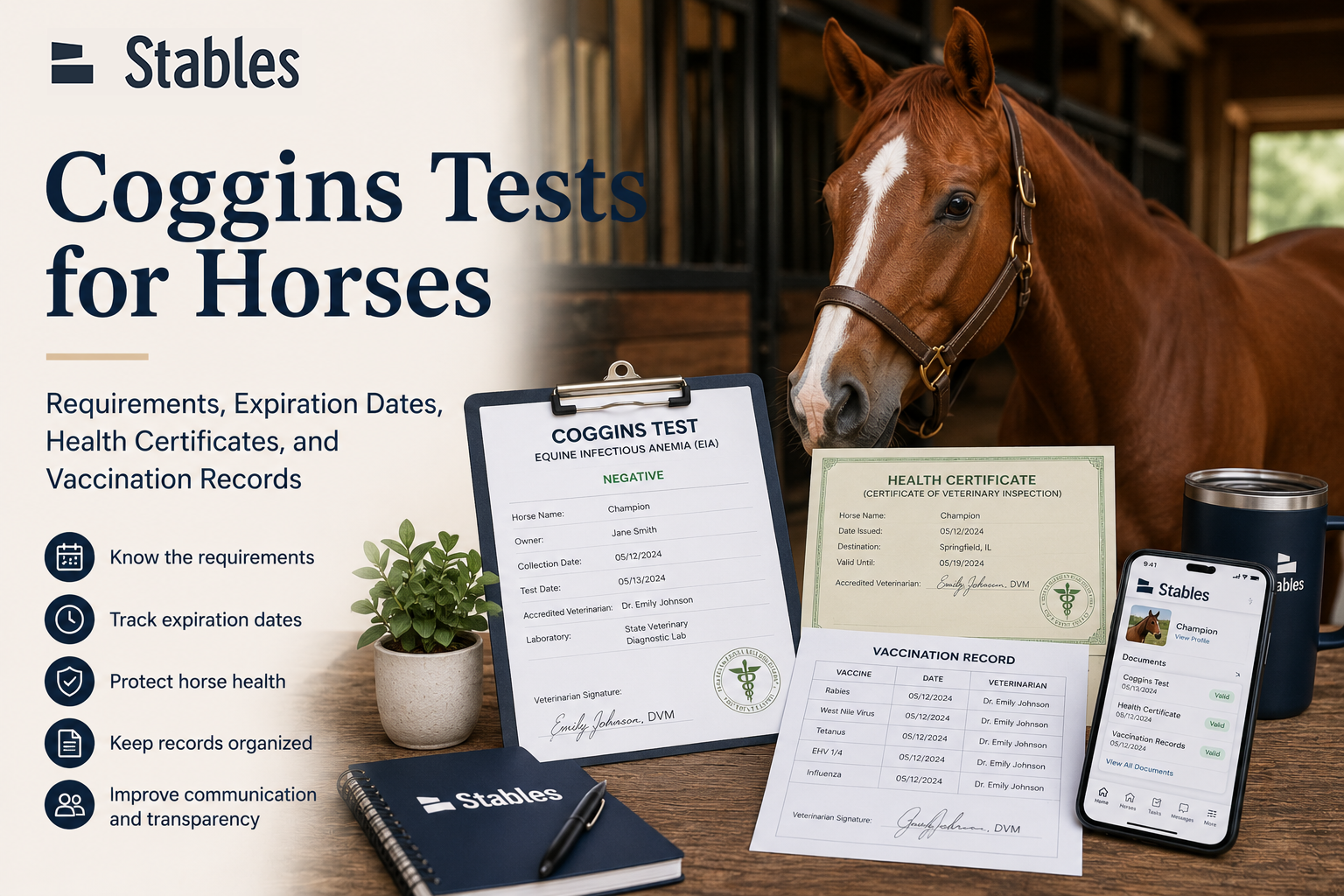
Coggins Tests for Horses: Requirements, Expiration & Travel Rules
If you've ever boarded a horse, attended a horse show, crossed state lines, or moved to a new facility, you've likely been asked to provide a copy of your horse's Coggins test.
For horse owners, trainers, and boarding facilities, maintaining current horse records is an essential part of responsible horse management. An expired Coggins test, missing health certificate, or outdated vaccination record can prevent a horse from traveling, participating in events, or moving into a boarding facility.
The challenge isn't usually obtaining the documents. The challenge is keeping them organized, accessible, and up to date.
Many horse owners still rely on paper folders, email attachments, text messages, and spreadsheets to manage important records. As facilities grow, tracking documentation manually becomes increasingly difficult.
In this guide, we'll explain what a Coggins test is, why facilities require one, how long it remains valid, and how modern horse management software can simplify record keeping for horse owners and boarding facilities alike.
What Is a Coggins Test?
A Coggins test is a blood test used to detect Equine Infectious Anemia (EIA), a contagious viral disease that affects horses.
Because there is no cure for EIA, preventing the spread of the disease is critical. Horses that test positive may face permanent quarantine or euthanasia depending on state regulations.
The purpose of a Coggins test is to identify infected horses and help protect the broader equine population.
As a result, most horse shows, competitions, boarding facilities, and transportation providers require proof of a current negative Coggins test before allowing a horse to participate.
Why Boarding Facilities Require Coggins Tests
Boarding facilities have a responsibility to protect the health and safety of every horse on the property.
Requiring a current negative Coggins test helps reduce risk and ensures horses entering the facility meet basic health requirements.
Many facilities require current documentation before:
- Moving into a stall
- Participating in group turnout
- Attending clinics or events
- Using shared riding arenas
- Traveling with other horses
As facilities grow, tracking compliance manually becomes difficult. Many barns use horse facility software to manage horse profiles, document expiration dates, boarding agreements, and health records in a centralized system.
How Long Is a Coggins Test Good For?
In most situations, a Coggins test is valid for 12 months from the date the blood sample was collected.
However, requirements can vary depending on:
- State regulations
- Breed associations
- Horse show requirements
- Boarding facility policies
- Interstate travel rules
Horse owners should always verify the requirements of their destination before traveling.
Even when a Coggins test remains technically valid, many facilities prefer updated records before expiration to avoid compliance issues.
What Happens If a Horse's Coggins Test Expires?
An expired Coggins test can create significant problems for both horse owners and facilities.
A horse may be unable to:
- Attend horse shows
- Enter competitions
- Cross state lines
- Move into a new boarding facility
- Participate in clinics or organized events
For boarding facilities, expired records often result in administrative headaches. Staff members spend valuable time following up with owners, requesting updated documentation, and tracking expiration dates manually.
This becomes even more challenging when managing dozens or hundreds of horses and this is exactly why modern facilities are using horse boarding software to manage everything digitally.
Coggins Tests vs Health Certificates vs Vaccination Records
Although these documents are often grouped together, they serve different purposes.
Coggins Test
Verifies that a horse has tested negative for Equine Infectious Anemia (EIA).
Health Certificate (CVI)
A health certificate, often called a Certificate of Veterinary Inspection (CVI), is issued by a veterinarian to certify that a horse is healthy enough for travel. Health certificates are frequently required for interstate transport.
Vaccination Records
Vaccination records document preventative care such as:
- Rabies
- West Nile Virus
- Tetanus
- Influenza
- Rhinopneumonitis (EHV)
Most boarding facilities require current vaccination records in addition to a negative Coggins test.
Many horse owners now use a digital horse owner portal to store and access these records rather than relying on paper copies.
The Hidden Problem With Horse Record Management
Most horse businesses don't realize how much time they spend managing records until they start tracking it.
Facilities often rely on:
- Email attachments
- Text messages
- Paper files
- Shared drives
- Spreadsheets
Over time, this creates problems:
- Missing records
- Expired documentation
- Duplicate requests
- Administrative inefficiencies
- Poor owner experiences
Owners become frustrated when they repeatedly have to send the same paperwork.
Staff become frustrated when records are scattered across multiple systems.
The result is wasted time and increased operational risk.
This is one reason more facilities are adopting modern equestrian management software to centralize operations.
How Modern Horse Management Software Simplifies Coggins Tracking
Modern horse businesses need more than file storage.
They need a system that keeps important records connected to the horse, owner, and facility.
With dedicated horse management software, facilities can:
- Store Coggins tests digitally
- Upload health certificates
- Track vaccination records
- Organize veterinary documents
- Maintain horse health histories
- Access records instantly when needed
This creates a single source of truth for owners, trainers, staff members, and facility managers.
Facilities already focused on improving owner transparency often find that centralized record management significantly reduces administrative workload while improving the customer experience.
Why Digital Horse Records Matter
As horse businesses become more sophisticated, digital record management is quickly becoming an expectation rather than a luxury.
When records are organized and accessible:
- Owners spend less time searching for documents
- Facilities spend less time requesting paperwork
- Trainers can access important information faster
- Veterinarians have better historical records
- Horses receive better continuity of care
Strong horse health record keeping practices improve both operational efficiency and horse welfare.
How Stables Helps Manage Coggins Tests and Horse Records
Stables helps horse owners and facilities organize important records in one connected platform.
Facilities can manage:
- Coggins tests
- Vaccination records
- Health certificates
- Veterinary records
- Farrier records
- Dental records
- Boarding agreements
- Horse profiles
Combined with tools for stall management, billing, payments, scheduling, and communication, Stables helps facilities run more organized and transparent operations.
You can view all available horse management features to see how Stables supports modern horse businesses.
Final Thoughts
A current Coggins test is one of the most important documents every horse owner should maintain.
But the real challenge isn't obtaining the test. It's keeping records organized, accessible, and up to date.
As horse businesses continue to modernize, more facilities are moving away from paper files and spreadsheets toward centralized systems that improve compliance, transparency, and operational efficiency.
Whether you're managing a single horse or an entire boarding operation, having access to accurate records helps create a better experience for owners, staff, and horses alike.
If you're looking for a better way to manage horse records, learn how Stables' horse management software helps facilities organize documentation, improve transparency, and simplify daily operations. You can also review pricing to see which plan is right for your facility.