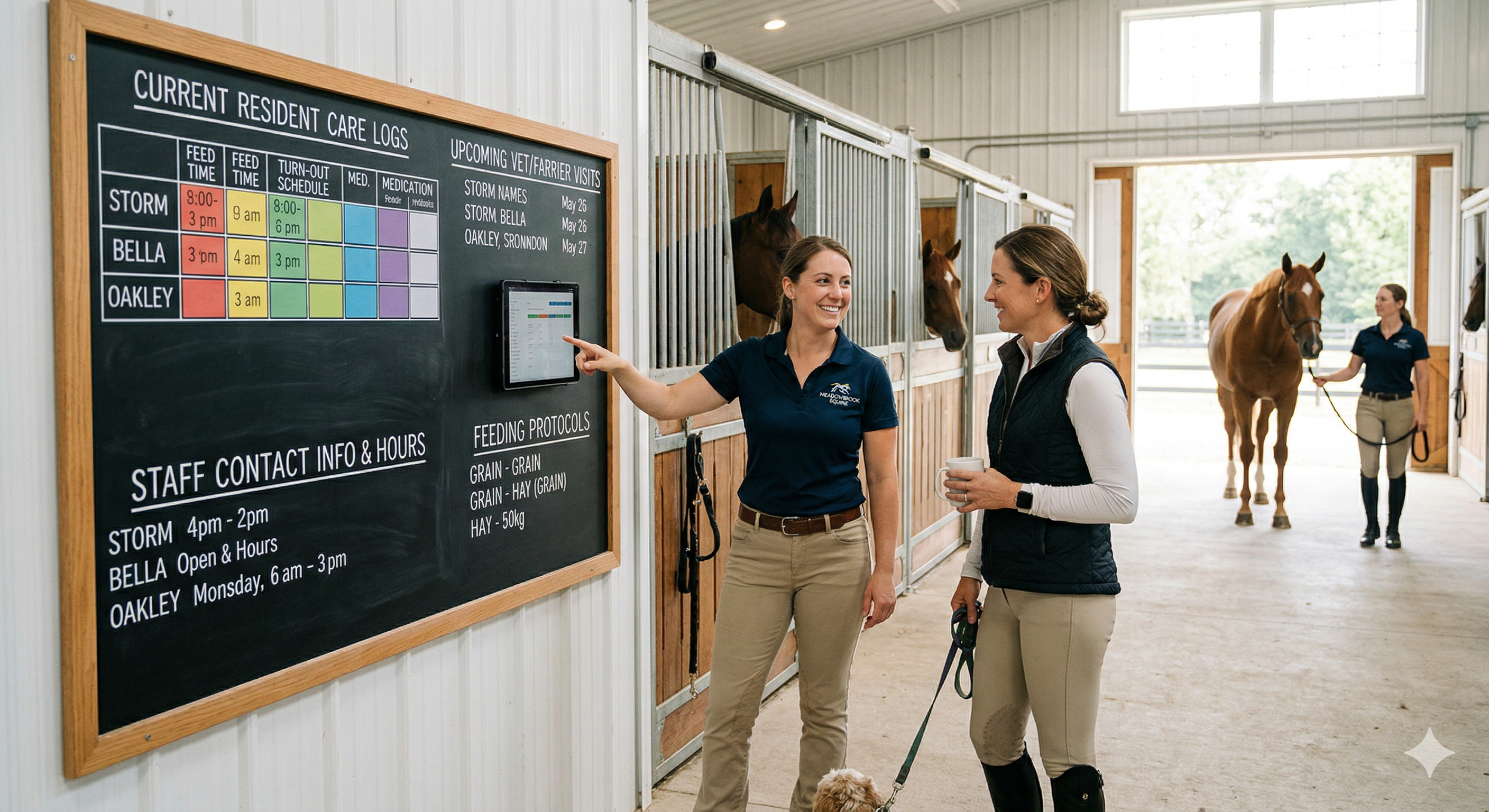
How to Improve Owner Transparency at Your Horse Boarding Facility
Boarding barn communication is one of the highest-leverage operational improvements a facility can make. You can have impeccably clean stalls, the best hay in the county, and a staff that genuinely cares. But if horse owners feel like they are dropping their animals off at a black box and hoping for the best, you will lose clients quietly and steadily while wondering why.
This guide covers the full picture: why owners feel uninformed, what a real documentation workflow looks like, how to build a smart notification strategy, what your owner portal should actually do, and what all of it is worth to your retention numbers. Emotion and operations are not separate conversations. At a boarding barn, they are the same conversation.
Why Owners Feel Like They Are in the Dark
Boarding an animal is an act of trust. An owner is handing you their horse, often their most significant emotional and financial investment outside of their home, and writing you a check every month with little visibility into what actually happened during that time. That is an uncomfortable position for anyone who loves their animal.
The black box feeling at boarding barns is not imaginary and it is not the result of owners being high-maintenance. It emerges predictably from a handful of structural failures in boarding barn communication:
- No proactive updates. Owners only hear from you when something is wrong. When no news arrives, anxious owners fill the silence with worry. A horse who is eating well, turned out on time, and happy in his stall generates zero contact with the barn under most communication models. That silence is not reassuring. It is a vacuum.
- Vague billing. A single line item reading "board" with no itemization of extra feeds, medications administered, or services rendered breeds quiet suspicion. Owners who feel unsure about their bill rarely ask directly. They just start looking around.
- Reactive-only contact. Phone tag, sporadic texts, and group chats are not a communication system. They are the absence of one. When the only moments of contact are emergencies or billing questions, the relationship feels transactional at best and adversarial at worst.
- No paper trail for care. When an owner asks whether their horse was turned out on a rainy Tuesday three weeks ago and your honest answer is "I think so," you have a trust gap regardless of what actually happened. Documentation is not just for liability protection. It is the raw material of owner confidence.
The facilities with the strongest retention are not always the most expensive or the most elaborate. They are the ones where owners feel informed, respected, and certain their horse is receiving the care they were promised.
This is not a soft management insight. It is a business reality with a direct line to your monthly revenue. The most common reason boarders leave without a prior complaint is a persistent and unresolved sense that nobody tells them anything. That is a systems problem, and systems problems have systems solutions by implementing horse boarding software in their facility.
Building Documentation Workflows That Actually Work
You cannot share information you have not captured. The foundation of good owner transparency is not charm or accessibility. It is documentation. Systematic, consistent, searchable documentation that makes the invisible work of horse care visible to the people paying for it.
Daily Care Logs
Every feeding, every turnout, every medication, every behavioral observation belongs in a log in your barn management software. The shift from "we know we did it" to "we have a record that we did it" is primarily a habit change, not a significant time investment. Staff members who resist it initially often become its strongest advocates once they see how many phone calls it eliminates.
A useful daily care log captures:
- Feed type, quantity, and any deviation from the standard program
- Turnout status, duration, paddock used, and behavior observed
- Water intake, especially critical in heat and cold
- Medications administered, dose, and who gave them
- Physical observations worth noting: heat in a leg, unusual manure, attitude change, small wound
- Farrier, veterinarian, or other service provider visits
The goal is not a novel. It is a timestamped record that gives any owner or staff member a complete picture of a horse's day without requiring a phone call.
Incident and Observation Protocols
Separate from daily logs, you need a clear protocol for what qualifies as an incident report and what happens when one is triggered. Minor cuts, loose shoes, a horse off feed for a single meal, and unusual behavior all sit in a gray zone where different barn managers handle things differently. Make it explicit.
A tiered protocol works well in practice:
- Tier 1, Observe and Log: Minor, non-urgent observations logged in the daily record. The owner can see it in their portal at any time, but no immediate alert is sent.
- Tier 2, Notify Within 24 Hours: Anything that warrants awareness but not emergency action. A minor wound, off feed, attitude change. Send a notification the same day with a brief description of what was observed and what, if anything, was done.
- Tier 3, Notify Immediately: Any situation requiring a veterinary call, significant injury, or unusual health presentation. Contact the owner and their emergency contact before doing anything else.
Having this written down and shared with all staff removes ambiguity and removes the "I did not want to bother them" hesitation that causes owners to learn about things days after they happened.
Contract and Care Plan Documentation
Every horse at your facility should have a signed, current boarding contract. Every service add-on, feeding deviation, or special care agreement should be documented separately and tied to that horse's record. When billing questions arise, and they will, the answer should be a two-second lookup, not a conversation from memory.
For facilities still using paper-based or spreadsheet systems, the gap between what is promised and what can be documented tends to widen over time. A platform built around care-to-billing integration closes that gap by design. The horse management software comparison guide at Stables breaks down which platforms handle this well and which treat it as an afterthought.
A Smarter Notification Strategy
Documentation gives you the content. A notification strategy determines how and when that content reaches owners. Most barns operate on one of two extremes: total silence or reactive firefighting. Neither builds trust. What builds trust is a structured, predictable rhythm of communication that owners can rely on.
The Three Types of Notifications Worth Sending
- Care confirmations: A simple daily or per-event confirmation that the horse was fed, turned out, or had a scheduled service completed. These require no action from the owner and take seconds to generate when logged through the right system. They are the single most effective trust-building communication a barn can send.
- Health and incident alerts: Any observation outside normal parameters. Sent promptly, clearly worded, with context about what action has been taken or is being considered. Never vague, never delayed.
- Billing notifications: Invoice generation, payment receipts, and upcoming charges for scheduled services. Sent before the bill is due, not after it has been ignored. A boarder who sees their invoice itemized clearly before it is due is dramatically less likely to dispute it after the fact.
Billing is one of the clearest parts of the owner experience. See what owners actually want from boarding facility billing transparency.
Channel Strategy: Meet Owners Where They Are
Different owners have different communication preferences, and those preferences shift by urgency. A health alert that goes to an email inbox a horse owner checks twice a week has failed its purpose. Build a channel map for your facility:
- Email: Monthly billing summaries, care plan updates, policy notices, and non-urgent health updates. Good for building a record that both parties can reference.
- SMS or push notification: Time-sensitive updates, incident alerts, payment confirmations, and appointment reminders. High open rates, immediate delivery.
- Owner portal: The source of truth. Everything logged, timestamped, and accessible at any time. The portal is where owners go to answer their own questions so they do not have to call you.
Barns that get this right report a dramatic reduction in inbound phone calls from worried owners. That is not a coincidence. It is a direct result of replacing silence with structure.
Let Owners Set Their Own Preferences
The right notification frequency varies by owner. Some boarders want a daily care summary. Others want to be contacted only when something warrants attention. Giving owners control over their notification settings is itself a transparency feature. It communicates that your operation is built around their experience, not around your convenience.
Owner Portal Best Practices
An owner portal is not a nice-to-have feature for tech-forward barns. It is the infrastructure of modern boarding barn communication. It is the place where documentation, notifications, billing, and health records converge into a single view that an owner can access from their phone at 11pm when they cannot stop thinking about whether their horse was turned out today.
Real-Time Care Visibility
Owners should be able to open the portal and see exactly what happened with their horse today. Feed log, turnout status, staff observations, upcoming appointments. This single feature eliminates the majority of "just checking in" phone calls and the anxiety that drives them.
The data needs to be current. A portal that shows information from two days ago is not a transparency tool. It is a false promise that makes the communication problem worse by raising expectations it fails to meet.
Health Records and Documents
Vaccination certificates, Coggins paperwork, deworming schedules, farrier logs, and veterinary visit records should all live in the portal, accessible to the owner at any time without requiring a call or an email to staff. When a horse is moving to a new facility or competing out of state, the owner should be able to pull everything they need without involving you.
The portal should also make it easy for owners to upload and share digital horse health records their own veterinarians or farriers have generated. Information flows in both directions in a well-designed system.
Billing Transparency That Removes Doubt
Billing is where most barn-owner friction originates. An invoice that arrives as a single number at the end of the month, with no line-item breakdown and no connection to the care records the owner can already see, invites suspicion even when the billing is entirely accurate.
A good owner portal shows billing in context:
- Itemized charges connected to logged services
- Running monthly total visible before the invoice is generated
- Payment history and receipts available on demand
- Security deposit balance shown separately from operating charges
When an owner can trace every dollar on their invoice back to a logged care event, billing disputes become rare. The math is visible. The record is clear. The conversation changes.
Structured Communication Within the Portal
Owners should be able to send non-urgent messages, requests, and updates through the portal without resorting to personal text messages or email chains that get buried. A structured message thread per horse or per topic keeps communication organized and on record for both parties.
For a detailed comparison of how owner portal features differ across platforms, the owner portal section of the Stables horse management software guide walks through which systems offer genuine transparency versus which offer a polished demo that provides limited real-world utility.
What Owner Transparency Does to Your Retention Numbers
Boarding barn retention is rarely discussed with the same rigor applied to sales and marketing, but it deserves to be. A facility that retains boarders at a high rate is a fundamentally different financial entity than one that is constantly replacing churned clients.
Consider the math at a facility boarding thirty horses at $700 per month:
- Monthly revenue: $21,000
- Annual revenue per boarder: $8,400
- Cost to find and on-board a replacement boarder: several months of vacancy, stall preparation, and marketing time
- Cost to retain an existing boarder through better communication: operationally minimal once systems are in place
A thirty-horse facility that improves retention from 80 percent annually to 90 percent annually has effectively added the equivalent of three full-paying boarders to its revenue without acquiring a single new client relationship. That is not a rounding error. That is a $25,000 annual swing on revenue you already had.
Retention is not a soft goal. It is one of the highest-ROI improvements a boarding barn can make, and boarding barn communication is the primary driver of whether clients stay or go.
The Referral Multiplier
Happy owners talk. Owners who feel like genuine insiders at your facility, who get proactive updates, can see their horse's care records at any time, and never have to wonder about their bill, become your most effective marketing channel.
The inverse is equally true. Owners who leave due to communication breakdowns do not typically stay quiet about it. Equestrian communities are small and connected. A reputation for being hard to reach or opaque about care travels faster than any advertising you could run.
The Staff Efficiency Argument
There is a compelling internal case for structured communication workflows as well. Every phone call from an anxious owner asking what happened during turnout is staff time that could have been avoided. Every billing dispute that requires pulling together records from multiple sources is an hour or more of manager time spent on a problem that should not exist.
Barns that implement systematic documentation and owner portals consistently report a significant reduction in inbound administrative calls. That reclaimed time does not disappear. It gets redirected toward actual horse care and the higher-value work of running a better facility.
A Practical Implementation Path
If your facility is currently running on phone calls, group texts, and spreadsheets, the shift to a structured communication workflow does not happen overnight. Here is a realistic path:
- Audit what you currently communicate. List every type of update, notification, and documentation your staff generates in a typical week. This baseline makes clear what needs to be systematized versus what is already working fine.
- Define your notification tiers. Before touching any software, align your team on what qualifies as an immediate alert, what goes in the daily log, and what gets surfaced in billing. Write it down and make it official.
- Choose a platform built for boarding operations. General equine software often treats owner communication and billing transparency as secondary features. Platforms built specifically for boarding facilities build them into the core workflow.
- Introduce the portal to current boarders before it is perfect. Waiting until everything is ideal means waiting indefinitely. Launch with your core features, communicate clearly to owners why it benefits them, and iterate from real feedback.
- Measure what changes. Track inbound owner calls per week, billing dispute frequency, and boarder tenure at six and twelve months. The numbers will tell you whether the system is working.
The Bottom Line
Boarding barn communication is not a peripheral operational concern. It is the mechanism through which you convert good horse care, which most facilities provide, into visible, trusted, client-retaining good horse care, which is a genuine competitive advantage.
The owners who feel like insiders do not leave. The ones who feel like they are outside a black box eventually do, usually without telling you why, and often while mentioning it to everyone they know at the barn down the road.
Build the documentation habits. Design the notification system. Run the owner portal the way owners actually want to use it. The investment is real but modest. The return, measured in retained monthly revenue, staff time recovered, and referrals generated, is substantial.
Stables is built from the ground up around owner transparency. From real-time care logs to itemized billing visible in the owner portal before invoices are generated, every feature connects back to the same goal: making the invisible work of horse care visible to the people who care most about it. See how it compares to the alternatives in our complete horse management software guide.