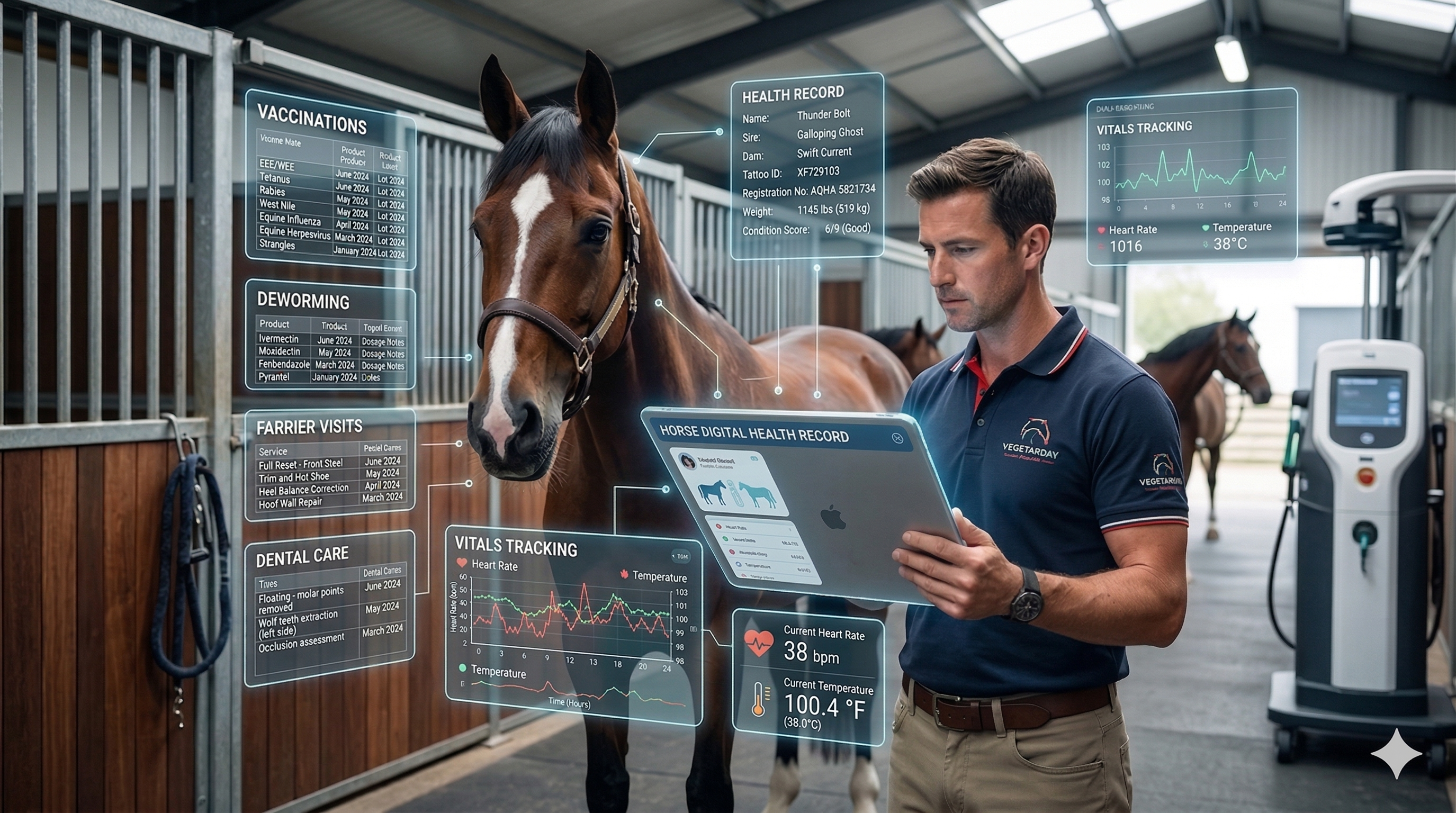
Digital Horse Health Record Keeping: Complete Guide for Boarding Facilities and Owners
Horse health record keeping is one of those tasks that every barn manager and horse owner knows matters, until the moment it actually matters and the records are not there.
A horse presents with colic symptoms and the vet asks when he last had a dental float. A buyer requests a Coggins certificate and you are digging through a filing cabinet. A farrier misses a trim cycle because nobody tracked the schedule.
Paper systems fail. Spreadsheets get outdated. Email chains get buried.
Digital horse health record keeping solves this by centralizing vaccination records, Coggins certificates, farrier schedules, and veterinary history in one system that is accessible, searchable, and always up to date.
This guide covers exactly how to set up a reliable system, including vaccination tracking, document storage, scheduling, owner portals, and compliance requirements for boarding facilities.
What Is Horse Health Record Keeping?
Horse health record keeping is the process of tracking and storing all medical, regulatory, and care-related information for a horse in a structured system.
A complete equine health record typically includes:
- Vaccination history and due dates
- Coggins certificates and health documents
- Farrier and dental schedules
- Veterinary visits and treatment notes
- Compliance and transport documentation
Modern barns are moving toward digital equine health record systems that replace paper files and spreadsheets with centralized, cloud-based records that can be accessed from anywhere.
Why Digital Horse Health Records Matter More Than Ever
The equine industry has always run on relationships and handshakes, but liability, interstate travel, and show regulations have made documentation non-negotiable.
A single missing health document can:
- Disqualify a horse from a competition or show
- Delay a sale by days or weeks
- Create legal exposure if vaccination history cannot be verified
- Force a vet to make decisions without full medical context
Beyond compliance, good records save money. When you track farrier cycles, dental appointments, and veterinary visits in one place, you catch deferred care before it becomes an expensive emergency.
The shift from paper to digital is not just about convenience. It is about reliability, accessibility, and real-time visibility.
If you are managing multiple horses, this is where most systems break down. A centralized platform like Stables keeps records, schedules, and communication in sync so nothing gets missed.
Before diving into specific record types, it is worth understanding why traditional systems fail.
Paper vs Spreadsheet vs Digital Horse Record Systems
| System | Risk Level | Common Failure Points |
|---|---|---|
| Paper records | High | Lost documents, no backups, hard to share |
| Spreadsheets | Medium | Outdated data, no reminders, manual entry errors |
| Digital systems | Low | Requires setup, but scalable and reliable |
Digital systems reduce risk by automating reminders, centralizing documents, and making records accessible across devices.
Vaccination Tracking: Building a Defensible Equine Health Record
Vaccination records are the foundation of any equine health file. For boarding facilities, they are also a liability management tool. If a horse contracts a preventable disease and the facility cannot produce vaccination records, the legal exposure is significant.
What to track for every horse:
- Vaccine name and manufacturer
- Date administered
- Lot number and expiration date
- Administering veterinarian
- Next due date
Core vaccines for most horses include Eastern and Western Encephalomyelitis, West Nile Virus, Tetanus, and Rabies. Risk-based vaccines like Influenza, Rhinopneumonitis, Strangles, and Potomac Horse Fever depend on geography, show schedules, and boarding environment.
Digital record keeping allows you to set automatic reminders when a vaccine is coming due, rather than relying on memory or a paper calendar. For boarding facilities managing dozens of horses, this automation is the difference between a system that works and one that does not.
Compliance note: Many competitions and shows require proof of current vaccinations within a specific window, often 6 months. Digital records that are timestamped and printable on demand keep you consistently show-ready. For a broader look at how facility software can absorb this kind of administrative load, see our breakdown of boarding barn software ROI.
Coggins Storage: The Document You Always Need and Never Have
A negative Coggins test (equine infectious anemia testing) is required for interstate transport, most competitions, many boarding facilities, and any horse sale. It is one of the most commonly requested equine documents and one of the most commonly missing.
Traditional paper Coggins certificates get lost, fade, or stay in the trailer when you need them at the barn. Digital storage solves this entirely.
Best practices for digital Coggins management:
- Scan or photograph the original certificate immediately upon receipt
- Store it in a searchable, cloud-based system attached to the horse's profile
- Set a reminder 30 to 60 days before the annual expiration date
- Ensure the document is accessible from a mobile device for roadside inspection
For boarding facilities, requiring proof of a current Coggins as a condition of entry and storing it digitally creates an audit trail that protects both the operator and the horses on the property.
With Stables for boarding facilities, document storage is built into each horse's profile. Coggins certificates, health certificates, and other regulatory documents live alongside vaccination records and scheduling history in one place, accessible from any device.
If you are still managing Coggins and health documents across email, paper, and text threads, this is where errors happen. Stables centralizes every document under the horse profile with reminders before expiration dates.
Farrier Scheduling and Tracking: Closing the Most Common Gap in Horse Care
Irregular hoof care is one of the leading causes of lameness in domesticated horses. A horse on a 6 to 8 week trim or shoeing cycle needs consistent scheduling, and yet farrier appointments are among the most frequently dropped in manual systems.
What a good farrier tracking system captures:
- Date of last service
- Type of service (trim, full shoe, front shoes only, corrective shoeing)
- Farrier name and contact information
- Notes on hoof condition or concerns flagged during the visit
- Next scheduled appointment
Hoof care is a key part of a horse’s care history. For farrier-specific workflows, read our guide to farrier service history and farrier management software.
For boarding facilities, tracking farrier visits across 30, 50, or 100 horses on varying schedules is genuinely complex. Some horses are on 5-week cycles, others are on 8-week cycles. Some owners have their own farrier, others use the barn's preferred provider. Without a centralized system, horses slip through.
Digital scheduling tools that send automated reminders to both the barn manager and the horse owner eliminate that problem. The farrier schedule becomes a shared, visible, accountable system rather than a mental note that gets forgotten.
Stall and herd management goes hand in hand with scheduling. Our guide to horse stall management software covers how digital barn tools handle the operational layer that health record keeping sits on top of.
Equine Dentist and Veterinary Visit Tracking
Dental health is underappreciated in equine care. Horses require dental floating (filing sharp points and correcting bite issues) typically once a year, sometimes more frequently for young horses, senior horses, or horses with known dental issues. Poor dental health directly affects a horse's ability to chew, maintain weight, and perform comfortably under saddle.
Veterinary visits cover a much broader range: wellness exams, lameness evaluations, chiropractic or acupuncture treatments, emergency calls, and ongoing management of chronic conditions.
For each dental or veterinary visit, record:
- Date and provider name
- Nature of the visit (routine, emergency, follow-up)
- Findings and diagnosis
- Treatments administered (including medications, dosages, and withdrawal times)
- Follow-up instructions
- Next recommended visit date
Why this matters for boarding facilities: Barn managers are often the first to notice signs of dental or health issues. When they can pull up a horse's full visit history instantly, they give the vet accurate, complete context at the start of every call. That saves time and can save the horse.
For owners keeping track of multiple horses, or boarding facilities managing complex health histories across a large herd, centralized digital records eliminate the guesswork. Everything is timestamped, searchable, and attached to the horse's permanent file. The Stables horse management software page covers how these features work together in a single platform.
Owner Portal Sharing: Giving Owners Real-Time Visibility
One of the most persistent friction points in the boarding relationship is communication. Owners want to know what is happening with their horses. Barn managers want to spend their time on care, not phone calls and texts.
A well-designed owner portal solves this by giving owners direct, self-serve access to their horse's records.
What owners should be able to see through a portal:
- Current vaccination status and upcoming due dates
- Coggins certificate and other stored documents
- Farrier and dental visit history
- Veterinary records and treatment notes
- Upcoming scheduled appointments
- Billing and invoices
This level of transparency does several things. It builds trust. It reduces the volume of routine questions to barn staff. It creates accountability in both directions: owners can see their horse is being cared for, and barn managers have a record of every service provided.
The Stables horse owner portal is designed specifically for this use case. Owners log in and see their horse's complete care record, communicate with barn staff, and pay invoices in one place. It turns a transactional boarding relationship into a long-term partnership.
Practical tip: When onboarding a new boarding client, walk them through the portal during the intake process. When owners understand from day one that they will have visibility into every aspect of their horse's care, it sets a professional tone and reduces the calls that drain staff time.
Document Storage: The Backbone of Equine Compliance
Beyond Coggins certificates, horses accumulate a substantial paper trail over a lifetime:
- Health certificates for interstate travel
- Import and export documentation
- Breed registration papers
- Insurance documentation
- Emergency authorization forms
- Farrier and veterinary contracts
- Boarding agreements
Traditional approaches scatter these documents across filing cabinets, email inboxes, and gloveboxes. Digital document storage consolidates everything in one place, searchable and accessible from anywhere.
For boarding facilities specifically: Maintaining digital copies of every horse's required documentation is a risk management practice, not just a convenience. When a health inspector, show official, or buyer asks for documentation, the response time is measured in seconds, not hours.
Document naming conventions matter. A file named Coggins_Dunbar_HalfCircleB_2024-09-15.pdf is infinitely more useful than scan0047.pdf. Build a consistent naming convention into your intake process and it pays dividends immediately.
The document storage capabilities within Stables attach files directly to horse profiles, so every document is associated with the specific animal it covers. No separate folder structures, no orphaned files.
Compliance Tips for Horse Boarding Facilities
Running a boarding facility comes with a real compliance burden. Missed steps create financial and legal exposure that is entirely avoidable with the right systems in place. For more on where facilities lose money through administrative gaps, our post on common horse boarding billing mistakes is worth reading alongside this one.
Here is a practical compliance checklist:
Vaccination compliance:
- Require proof of core vaccines as a condition of boarding
- Set facility-wide renewal reminders 45 days before expiration
- Keep copies of every horse's vaccination record on file, not just the owner's word
Coggins compliance:
- Require a current Coggins before a horse arrives on property
- Track expiration dates and notify owners 30 days in advance
- Do not accept horses without a current Coggins, regardless of the circumstances
Interstate transport:
- Maintain health certificates for any horse leaving or entering your state
- Know your state's specific requirements, which vary and update periodically
- Keep a copy of every health certificate issued for horses in your care
Treatment authorization:
- Have signed emergency treatment authorization on file for every horse
- Review and update annually
- Store digitally so it is accessible if an emergency happens after hours
Billing accuracy: Accurate health records protect your revenue too. When veterinary care, farrier visits, and supplements are tied to a digital record that flows into the billing system, nothing gets forgotten. See how Stables automates horse boarding invoices to understand how record keeping and payments connect in a modern facility management platform.
Moving from Paper to Digital: A Practical Migration Plan
If your facility is currently paper-based or spreadsheet-based, migration to a digital system does not have to be overwhelming. Here is a practical approach:
Phase 1 - Establish the baseline (Week 1 to 2)
Start with the horses currently in your care. For each horse, collect: current Coggins, most recent vaccination records, farrier schedule, and any active treatment notes. Do not try to digitize years of old records in one pass. Focus on what matters today.
Phase 2 - Set up profiles and upload documents (Week 2 to 3)
Enter each horse into your digital platform, upload the documents collected in Phase 1, and set reminder dates for upcoming vaccinations, farrier visits, and dental appointments.
Phase 3 - Onboard owners to the portal (Week 3 to 4)
Invite owners to access the portal. Walk them through where to find their horse's records and how to view upcoming appointments and invoices. Owner adoption is highest when they see value immediately.
Phase 4 - Establish intake protocols (Ongoing)
Every new horse that arrives at your facility should enter the system on day one, with all required documentation uploaded before the horse sets foot in a stall. Make it a condition of boarding, not an afterthought.
If you are evaluating platforms, the Stables launch announcement gives a solid overview of what the platform was built to solve and why it is structured around payments and care records working together.
The Bottom Line
Digital horse health record keeping is not a luxury or a future-state goal. It is a practical necessity for any facility or owner who takes equine care seriously. The combination of vaccination tracking, Coggins storage, farrier scheduling, veterinary visit documentation, and owner portal sharing creates a complete, defensible, accessible health record that protects the horse, the owner, and the facility.
Paper systems and spreadsheets cannot deliver that. A purpose-built platform can.
If you are ready to move your barn off paper and into a system that actually works, explore Stables and see how facilities like yours are managing health records, scheduling, and payments in one place.
This article was written by the team at Stables, an equestrian facility management and payments platform built by horse owners, for horse owners.