Why Your Horse Boarding Barn Needs a P&L Statement
A profit and loss statement sounds like something that belongs in a corporate boardroom. It doesn't. It belongs in every business that takes in money and spends money, which includes your boarding barn whether you have five stalls or fifty.
The P&L is not complicated. It's not a tax document. It's a single view of one question: did your operation make or lose money in a given period, and by how much? That's it. And the answer to that question, tracked consistently over time, is the most useful thing you can know about your business.
Most boarding barns don't have one. That's not because barn managers aren't smart. It's because the horse boarding software built for horse operations were designed around horse management, not financial management.
What a P&L Statement Actually Is
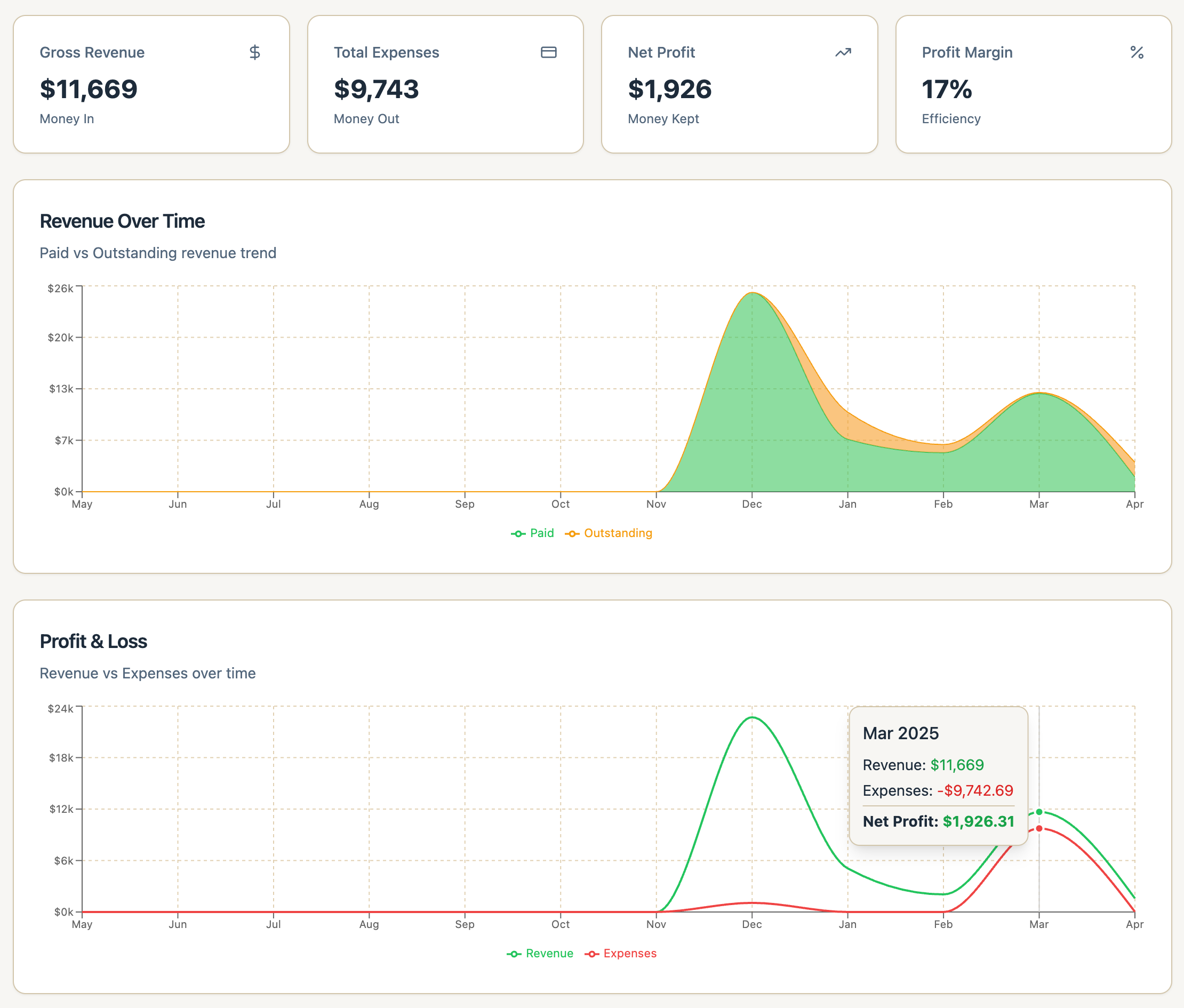
A P&L statement lists your revenue at the top, your expenses below it, and your net income at the bottom. That's the entire structure.
Revenue is everything you collected during the period: board fees by category, training add-ons, arena rental, lessons, any other service you charged for.
Expenses are everything you spent during the period: feed and hay, labor, utilities, farrier visits, veterinary supplies, equipment maintenance, insurance, software, any other operating cost.
Net income is revenue minus expenses. Positive means you made money. Negative means you lost money. The percentage you get when you divide net income by revenue is your margin.
What a P&L Tells You That Nothing Else Does
Without a P&L, the information you have is fragmentary. You know roughly how much board you billed. You know your feed bill. You have a general sense of labor costs. But you're holding all of these pieces separately in your head, and the human mind is genuinely bad at doing accurate arithmetic on a set of numbers it can only partially recall.
The P&L puts all of those pieces in one place at the same time. And when they're all in one place, things become visible that weren't visible before.
You might discover that your full-care board rate is actually producing a margin below 20% after all direct costs are included. You might discover that your labor costs jumped significantly in the spring and you never adjusted pricing to compensate. You might discover that your pasture board stalls are actually your highest-margin stalls because feed costs are a fraction of full care.
The Margin Benchmarks Worth Knowing
Full-care boarding at a well-run facility typically produces a net margin between 30% and 50%. Margins below 20% indicate either underpriced board, high expenses relative to revenue, or both.
Pasture boarding can run higher margin percentages because the cost per horse is dramatically lower. The board rate might be 50% to 60% of full care, while the cost might be 30% to 40%. The math often works in favor of mixed operations.
Building Your First P&L This Month
You don't need an accountant to build a P&L for a boarding operation. You need a spreadsheet and one to two hours.
Pull every bank transaction from the past month. Categorize each one as either revenue or expense. Group expenses into four or five categories: feed and supplies, labor, facilities and utilities, professional services, everything else.
Add the revenue. Add the expenses. Subtract. Calculate the margin.
Do it again next month. The second one will be faster and cleaner. By month three, you'll have a baseline that tells you whether your business is trending in the right direction.
When the P&L Connects to Your Barn Payment System
The P&L becomes genuinely powerful when it populates automatically from your collection and expense data rather than from manual spreadsheet entry.
When your board payments flow through an integrated payment system, every collected payment, every failed charge, every refund is already categorized and timestamped. When you log expenses against the same system, the P&L builds itself in real time.
This is what we built at Stables. A payments-first platform where the Barn P&L is a real-time output of real transaction data. You can explore the full features or read about boarding barn software ROI to understand what the financial visibility layer actually delivers.
Related Reading
- Is Your Horse Boarding Barn Actually Profitable?
-How to Automate Horse Boarding Invoices at Your Barn (Step-by-Step Guide)
-Boarding Barn Software ROI:How to Calculate the Real Return