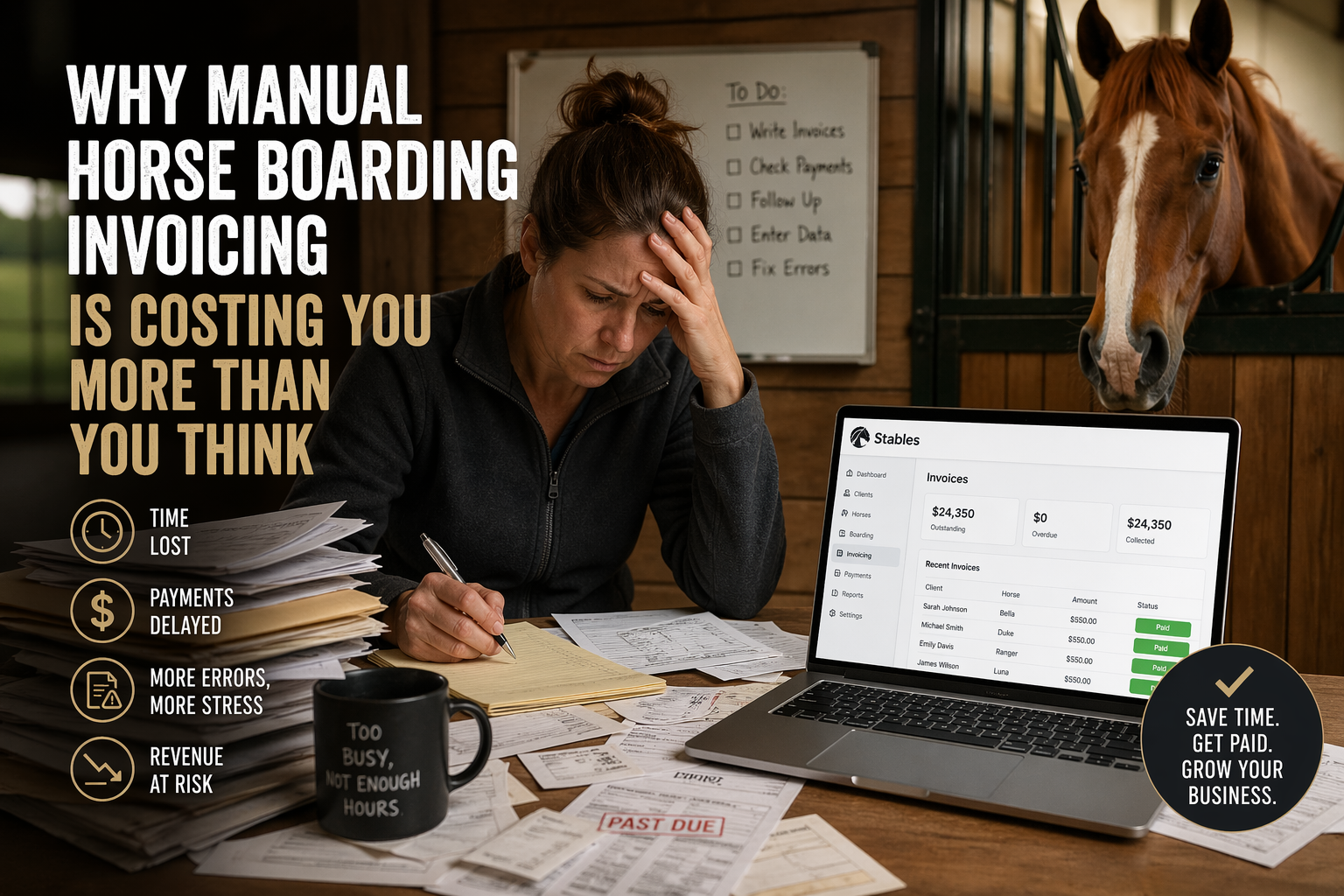
Why Manual Horse Boarding Invoicing Is Costing You More Than You Think
There's a version of manual invoicing that feels fine: you send the invoices at the start of the month, most people pay within a week or two, and the operation keeps moving. It's imperfect but it works.
That version of the story hides what's actually happening underneath. Manual invoicing creates a specific set of conditions that compound over time into delayed payments, billing errors, collection conversations, and administrative overhead that quietly consumes your time and damages your margins.
The Error Rate Problem
Manual invoicing introduces errors. Not because you're careless. Because the process is error-prone by design.
When you're building invoices in a spreadsheet or Word document, you're re-entering information that already exists somewhere else: the board rate, the services attached to each horse, the add-ons that were added or removed mid-month. Every re-entry is an opportunity for a mismatch between what you meant to charge and what you actually charged.
Common errors include: the wrong board rate applied because you updated rates for some boarders but not all; an add-on service that was added mid-month and didn't make it onto the invoice; a credit from last month's overpayment that wasn't applied.
Boarding facilities using manual invoicing typically have an error rate between 3% and 8% per billing cycle. At 40 stalls, that's one to three invoices with some kind of issue every single month.
The Timing Problem
Manual invoicing sends payments later than they need to be.
If you invoice on the 1st, some boarders receive the invoice and pay within two or three days. Others set it aside. Others forget. The natural distribution of payment timing means a meaningful percentage of payments arrive in the second or third week of the month even when the due date is the 1st.
The gap between your due date and your average collection date is your cash float: money you've earned but don't have yet. In a 40-stall operation at $750 per stall, a 10-day average collection lag means you're floating roughly $10,000 in earned revenue at any given time.
Automated invoicing with card-on-file or ACH collection collapses this lag from 10 to 15 days to 1 to 2 days. The math on what that does to your cash position compounds significantly over a year.
Manual invoicing creates problems for both barns and owners. Here is what horse owners want from boarding invoices and why it matters.
The Follow-Up Labor Problem
Every invoice that doesn't get paid on time generates follow-up work. Map the actual labor for a single late payment: notice the invoice hasn't been paid by day 7, send a reminder email, check back in three days, send a text, boarder says they'll handle it, check back two days later. Four to six individual communications spanning two weeks for a single late payment.
Automated billing with payment reminders, retry logic on failed payments, and real-time collection tracking eliminates most of this labor. When the system handles the follow-up automatically, your involvement becomes the exception rather than the routine.
The Consistency Problem
Manual invoicing is only as consistent as the person doing it on the day they're doing it. On a busy week, invoices go out late. During the holidays, timing shifts. Each inconsistency trains boarders that your billing schedule is approximate, which trains them that their payment timing can be approximate as well.
Consistency in billing creates consistency in payment. Boarders who receive their invoice on the same day every month develop predictable payment habits.
The Real Conversation to Have
The question isn't whether to fix manual invoicing. It's whether the cost of fixing it is worth the cost of keeping it.
For a 20-stall operation or larger, the error rate, float cost, and labor overhead of manual invoicing almost always exceeds the cost of automation significantly.
Read about common billing mistakes boarding barns make and how automated invoicing changes the collection picture. Stables was built specifically for this problem, and the boarding barn software ROI article walks through the actual math on what the switch is worth financially.
Related Reading
- How to Automate Horse Boarding Invoices
- Common Horse Boarding Barn Billing Mistakes
- The Real Cost of a Late Board Payment