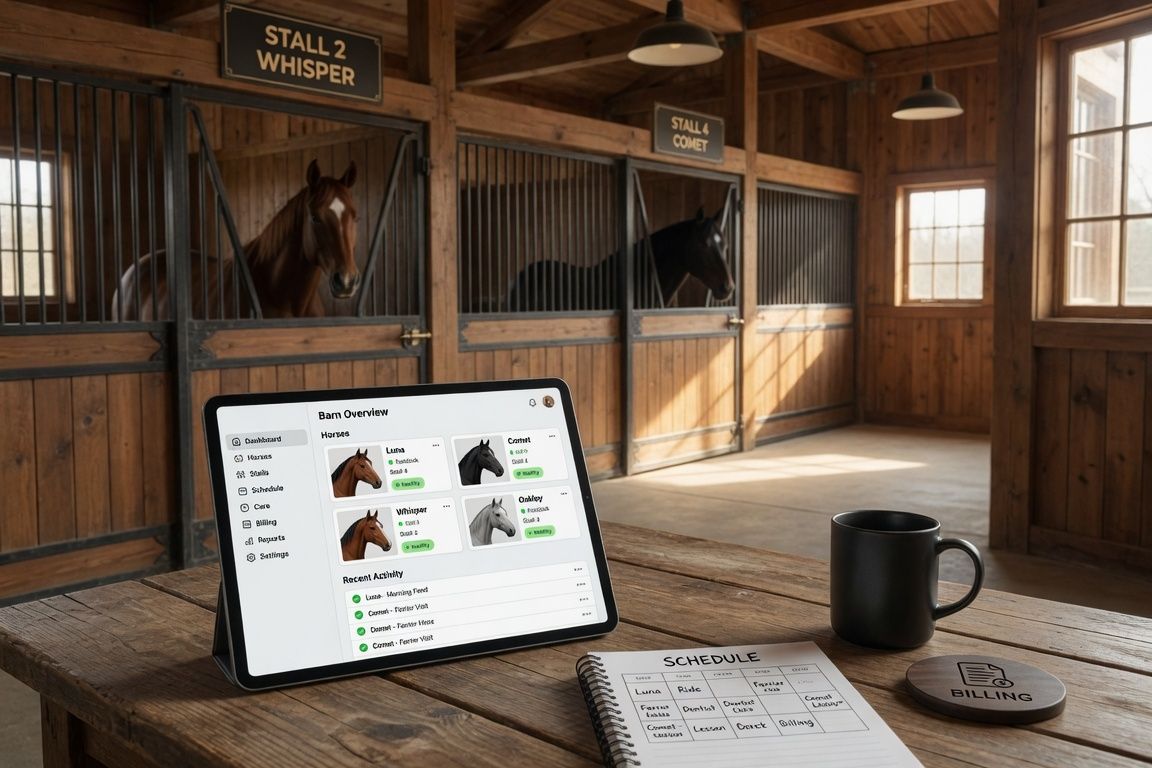
7 Best BarnManager Alternatives for Boarding Facilities (2026)
Boarding facility owners comparing 7 BarnManager alternatives for boarding facilities in 2026 will find options ranging from legacy record-keepers to modern barn management software built around billing and collection. This guide covers care tracking, scheduling, recurring billing, and owner communication across the field, so you can choose the tool that fits how your barn actually runs and gets paid.
Why Boarding Facility Owners Are Looking Past BarnManager
BarnManager established itself on care coordination and owner communication. For facilities that primarily needed digital care logs and a way to relay updates to horse owners, it filled a real gap. But as boarding operations have matured, the gap between care tracking and actual revenue collection has become the more pressing problem.
The core issue is this: logging a farrier visit and billing for a farrier visit are two different workflows. Tools designed around care coordination do not automatically handle recurring board billing, add-on charge capture, or online payments. When boarding barns are chasing down monthly checks or manually assembling invoices from scattered care notes, that is a revenue leakage problem, and it compounds across every missed charge and slow-pay month.
The seven alternatives below cover a range of approaches to these problems, from traditional records-focused tools to purpose-built care-to-cash platforms.
The 7 BarnManager Alternatives for Boarding Facilities in 2026
1. Stables: Built for Care-to-Cash Operations
Stables connects care tracking, billing, and owner communication in a single workflow, removing the barn admin patchwork of spreadsheets, invoicing apps, and manual follow-up that most boarding facilities accumulate over time.
The platform centers on recurring board billing with built-in add-on charge capture. When a farrier visit, grain change, or supplement addition is logged in the system, it flows directly into the next invoice rather than requiring a separate data entry step. Owners get access through an owner portal where they can view care records, upcoming charges, and pay online with a credit card on file for autopay or through a one-time payment.
The stall management and facility dashboard give operators real-time visibility across their barn without switching between tools. For boarding operations where missed charges represent a real financial concern, the connection between daily care and collected revenue is what makes Stables a different category than a standard records tool.
Best for: Boarding barns and equestrian facilities that want to capture more revenue, collect faster, and reduce admin work through a connected care-to-cash workflow.
2. Stable Secretary
Stable Secretary is one of the longest-standing names in barn management software. Originally built as desktop software, it has expanded into a web-accessible platform covering horse health records, feeding schedules, vaccination tracking, and basic billing functions.
For facilities that have used Stable Secretary for years, the institutional knowledge embedded in their data carries real switching cost. The platform handles detailed horse health records and care tracking well. On the billing side, recurring board billing and automated charge capture are less developed compared to newer platforms built with payment collection at the center. Staff relay care updates through the system, but owner-facing portals and online payment options are more limited than what modern boarding clients tend to expect.
Best for: Smaller operations prioritizing detailed horse health records and comfortable with more manual billing and payment collection workflows.
3. EquineGenie
EquineGenie takes a broad approach to equine farm management, covering horse health records, breeding management, financial tracking, and inventory across multiple disciplines. It is built for operations running boarding, training, breeding, and sales under one system.
The platform has real depth on the health and breeding records side. For a boarding barn whose primary need is billing accuracy and owner communication, EquineGenie carries more complexity than most operations need, and its billing workflows are not oriented around recurring board billing and add-on charge capture the way dedicated boarding platforms are.
Best for: Multi-discipline equine facilities that need breeding, health, inventory, and financial records in one system.
4. Paddock Pro
Paddock Pro positions itself as a mobile-first care tracking and scheduling app for equestrian facilities. The focus is on daily task management, feeding logs, and staff scheduling, making it a practical option for barns whose primary operational pain is coordinating staff and care routines.
The mobile experience is a strength for staff doing barn rounds with a phone in hand. For boarding facilities with recurring invoice needs, add-on charge capture, or online payment requirements, Paddock Pro addresses the scheduling and care side but leaves billing and collection workflows to external tools.
Best for: Facilities focused on staff scheduling, daily care logs, and mobile access to task management.
5. EQware
EQware is an equine management platform oriented toward larger boarding and training operations. It covers horse records, health tracking, and financial reporting at a scale suited to facilities managing large numbers of horses across multiple fields and disciplines.
For mid-size boarding barns, EQware can require more setup and configuration than the operation warrants. Billing functions exist within the platform but tend to require more manual assembly than systems built with recurring board billing and automated charge capture at the center. The owner-facing experience is less developed than what modern boarding clients expect from stable management software.
Best for: Larger equestrian operations and training centers that need depth in records management and reporting across a large herd.
6. Horse Keeper
Horse Keeper is a simplified record-keeping app built primarily for individual horse owners rather than commercial boarding operations. It covers basic health records, vaccination tracking, farrier scheduling, and vet visit logs in a clean, accessible interface.
For a boarding barn managing multiple horses, owners, billing cycles, and staff workflows, Horse Keeper is not designed for that use case. It lacks recurring billing, owner portals, and the charge capture tools a commercial facility needs. It may serve individual horse owners well, but it does not function as an equestrian operating system for a boarding business.
Best for: Individual horse owners or micro-facilities that need personal care logs without commercial billing requirements.
7. HorseBase
HorseBase offers horse records and care management with scheduling features, accessible via mobile and web for barn staff and horse owners. It covers basic care logs, health records, and appointment tracking, with an interface suited to smaller operations.
For commercial boarding barns that need recurring board billing, add-on charge capture, autopay, and owner portals for online payments, HorseBase is better suited as a care coordination tool than a complete barn management platform. As with several tools on this list, the billing and payment collection side would require supplementing with separate software.
Best for: Small facilities and individual barn operators looking for a mobile-accessible care log and scheduling tool.
Five Questions to Guide Your Software Decision
Choosing among these 7 BarnManager alternatives for horse boarding facilities in 2026 comes down to which operational problems cost you the most time and money each month. These five questions help identify the right fit:
Does your billing currently capture every add-on charge? If farrier visits, supplement changes, blanketing, or grain deliveries are not reliably appearing on invoices, you have a charge capture problem. Look for platforms where care events feed directly into billing rather than requiring a separate manual entry step.
Do your owners expect online payment options? Modern boarding clients expect to pay with a credit card on file or through an online owner portal. Tools that do not support autopay or online payments add friction to every monthly collection cycle.
How critical is mobile access for your staff? Staff relay care information in real time during barn rounds. If your team logs care notes from a phone, mobile usability is a core requirement of your management software, not an optional feature.
What does your owner visibility look like today? Owners who can log into a portal and see care records, upcoming charges, and invoices make fewer inbound calls and report higher satisfaction with their boarding barn. Tools focused only on internal staff workflows leave that communication gap open.
Are you running multiple revenue streams? Training services, clinics, farrier coordination, and add-on services all represent revenue that needs to be captured and billed accurately. Platforms built around a single boarding use case may not accommodate multi-stream billing cleanly.
Frequently Asked Questions
What is the biggest difference between BarnManager and care-to-cash platforms? BarnManager's core focus has been care coordination and owner communication. Care-to-cash platforms like Stables build billing and payment collection as first-class features, so recurring board billing, add-on charge capture, and online payments are integrated into the same workflow as daily care tracking rather than requiring separate billing tools.
Is barn management software worth the cost for a small boarding barn? For most boarding operations, the question is less about software cost and more about revenue leakage through missed charges, manual invoicing, and slow collections. A platform that captures even a few previously missed add-on charges per horse each month can offset its own cost at a small barn without complex setup.
Does Stable Secretary still work for modern boarding facilities? Stable Secretary remains a functional tool for horse health records and basic management, especially for facilities already running on its workflows. Its limitations show up most in billing automation, owner-facing portals, and mobile access, which are areas where newer barn management software platforms have built more complete solutions.
How does owner portal access affect monthly billing collection? Owner portals that surface upcoming charges, past invoices, and care records reduce billing disputes and inbound questions. When owners can log in, see their balance, and pay online with a saved card on file, collection cycles move faster and require less staff follow-up each month.
What is care-to-cash in barn management? Care-to-cash describes the workflow from logging a care event, such as a farrier visit, supplement addition, or blanketing service, through billing and collecting payment for that event. Horse boarding software or tools that break the chain between care records and billing create manual work and increase the risk of missed charges and revenue leakage across the barn.
Connect Care and Billing in One Place
If missed charges, slow collections, or disconnected workflows are costing your boarding facility real revenue each month, the right platform closes that gap automatically. Explore horse facility software built specifically for boarding barns to see how care tracking, recurring billing, and owner payments connect in one place.