
Security Deposit Tracking Software for Boarding Barns: What Every Facility Owner Needs to Know
If you run a boarding barn, you have probably collected a security deposit at least once. Maybe you logged it in a spreadsheet, dropped it into your general bank account, and made a mental note to sort it out when the boarder eventually moved on. That approach is more common than most barn managers admit, and it creates real financial and legal exposure that compounds over time.
Security deposit tracking is one of the most overlooked operational risks in the equine industry. Unlike monthly board payments, deposits occupy an unusual position in your books. They are not revenue. They are not yours to spend. They are a liability held in trust until a legitimate, documented reason to retain some or all of the funds arises. Yet without dedicated security deposit tracking software, most facilities treat them as if they were just another payment.
This guide covers everything a boarding barn facility owner needs to know: why deposit tracking matters, where manual processes break down, what compliance looks like in practice, how to evaluate software options, and what best practices protect you when disputes arise.
Why Proper Security Deposit Tracking Matters for Boarding Barns
Most barn owners think of security deposits as a simple protective measure. And they are, but only if they are managed correctly. Poorly handled deposits create four distinct categories of risk that proper tracking directly addresses.
Financial Protection
Security deposits act as a financial safeguard against property damage, breach of contract, and outstanding balances. That protection only holds if you can demonstrate that the funds were properly collected, held, and applied. A deposit you cannot account for is a deposit you cannot defend.
Legal Compliance
State and local laws often govern how security deposits must be held, how much can be charged, and how quickly funds must be returned after departure. Failure to comply can result in penalties, forced double-refunds, or legal liability. The requirements vary by jurisdiction, but the need for documentation is universal.
Transparency and Trust
Clear, accessible deposit records build trust between barn owners and boarders. Horse owners who can see exactly what they paid, under what conditions the deposit may be retained, and when they can expect a refund are far less likely to become adversarial at departure. Transparency is a relationship asset, not just an accounting nicety.
Operational Efficiency
Tracking deposits manually eats time that could go toward horse care, customer relationships, and barn operations. Automating deposit recording, notification, and refund processing eliminates a category of administrative work that has no upside when done by hand and significant downside when done poorly.
Liability vs. Revenue: The Most Common Security Deposit Mistake
The most widespread error boarding facilities make is depositing client security deposits into their operating account alongside regular revenue. On the surface, this seems harmless. The money is sitting there, you know whose it is, and you plan to address it when the boarder eventually leaves.
The problem is that a security deposit is a liability, not income. Until you have a legitimate, documented reason to retain some or all of it, that money belongs to the horse owner. Treating it as revenue means your financial statements are overstated, your tax filings may be incorrect, and you have no clear picture of what you actually owe back to clients at any given moment.
Consider this: if every boarder at your facility left tomorrow and demanded their deposits back, could you pay all of them? If deposits are commingled with operating funds, the honest answer is often no.
Proper security deposit tracking software keeps deposit funds in a separate ledger from the moment of collection. This separation makes it immediately clear what you owe, to whom, and since when. It also makes your financial statements accurate, which matters to lenders, accountants, and anyone else who looks at your books.
When comparing barn management platforms, look for tools that handle deposits as a distinct account type. The payment features section of our barn management software comparison covers which platforms distinguish deposit accounts from general revenue and which lump everything together.
Accounting Risk: Where Manual Deposit Tracking Breaks Down
Spreadsheets and handwritten logs are not deposit management systems. They are workarounds, and the risk they create compounds over time. Here are the most common failure modes.
- Misclassification: Deposits recorded as revenue inflate gross income and distort profit margins, creating tax exposure.
- Lost records: Spreadsheet rows get deleted, overwritten, or simply forgotten during staff transitions.
- Missing audit trail: No clear log of when deposits were paid, how much was collected, or what conditions applied at the time.
- Undocumented refunds: Deposits partially refunded by cash or check outside the system leave no traceable record.
- Timing violations: Deposits held longer than the agreed or legally required window create dispute exposure.
- Reconciliation failures: Manual deposit records that drift from bank statements are difficult and time-consuming to unwind.
Each of these errors creates a different category of risk. Misclassification is a tax problem. Lost records are a dispute problem. Undocumented refunds are a legal problem. When they stack together, as they often do in facilities relying on manual processes, you have a situation that is expensive and time-consuming to correct even if no one is actively challenging you.
Dedicated security deposit tracking software eliminates each failure point by creating a structured, time-stamped record from collection through final disposition. Every action has a timestamp, a user, and a reason.
Refund Workflows: Getting Departure Right
When a boarder leaves, the deposit process typically goes one of two ways. Either the barn manager scrambles to remember the original terms and ends up issuing a full refund to avoid conflict, or they make deductions without adequate documentation and invite a dispute. Neither approach is correct.
A proper refund workflow has defined steps that should happen in order every time:
- Review the boarding agreement: Confirm the exact deposit terms, including allowable deductions and the refund timeline the boarder agreed to.
- Conduct a thorough move-out inspection: Walk the stall and any other areas the boarder occupied. Document the condition with photos and written notes, just as you should have done at move-in.
- Calculate outstanding balances: Check for any unpaid board, training, farrier, or other charges that may offset the refund.
- Prepare a written deduction summary: Itemize every deduction with a specific reason and supporting documentation. Vague deductions invite challenges.
- Issue the refund for the remaining balance: Process the refund through your payment system within the agreed timeframe so the transaction is traceable.
- Provide a refund statement to the departing owner: Send a written breakdown showing the original deposit, each deduction with its reason, and the final refund amount.
Horse owner disputes about deposits are one of the most common sources of conflict in boarding relationships. In most cases the barn is in the right, but cannot prove it because the documentation simply does not exist. A single itemized refund statement eliminates most post-departure disputes before they start.
Modern horse boarding facility security deposit tracking software walks you through each step, preserves the boarding agreement terms at the time of collection, and generates a refund summary that can be shared directly with the departing owner. The refund itself initiates through the platform, creating a traceable payment record tied to the original deposit transaction.
Compliance Best Practices for Boarding Barn Security Deposits
There is no single national standard governing security deposits for equine boarding facilities. State laws vary, boarding agreement terms vary, and industry norms vary. That said, certain practices reduce risk regardless of your jurisdiction.
Define Deposit Terms Explicitly in Your Boarding Agreement
Your boarding agreement should specify the deposit amount, what it covers, how long you have to issue a refund after departure, and what conditions allow you to make deductions. Vague language creates disputes. Specific, signed terms protect you.
For a detailed look at what boarding agreements should include around deposit terms and payment conditions, see the deposit compliance section of our software comparison guide.
Keep Deposit Funds Separate from Operating Accounts
Whether you maintain a separate bank account or a software ledger that clearly distinguishes deposit balances from revenue, the separation needs to be real, visible, and reconcilable. If a state regulator or a departing boarder asks to see your deposit records, you should be able to produce them within minutes.
Conduct and Document Move-In and Move-Out Inspections
Property condition documentation is the foundation of any valid deduction. Photograph and describe the stall condition at move-in, have the boarder acknowledge it, and repeat the process at move-out. Without before-and-after documentation, damage claims become he-said-she-said disputes you may not win even when you are right.
Establish a Standard Refund Timeframe
Even if your state does not mandate a specific refund window, setting one in your boarding agreement and communicating it clearly gives you a defined obligation and protects you from open-ended expectations. A 14 to 30 day refund window, clearly stated in writing, gives you time for a proper inspection and calculation without creating uncertainty.
Make Deductions Only for Documented, Specified Reasons
Allowable deductions should be defined in your boarding agreement before any dispute arises. Repairs beyond normal wear and tear, outstanding balances, and breach of notice requirements are common examples. Each deduction you apply should be supported by written documentation and, where applicable, photographs.
Reconcile Deposit Records Regularly
Compare your deposit records in the software against your bank statements on a regular schedule, monthly at minimum. Discrepancies that are caught early are straightforward to correct. Discrepancies that compound over months become auditing problems.
Communicate Proactively with Boarders
Keep horse owners informed about the status of their deposits throughout the boarding relationship, not just at departure. An owner who receives a clear deposit confirmation at move-in and periodic visibility into their account balance is far less likely to treat the refund process as adversarial.
Consult a licensed attorney in your state to confirm that your specific practices align with any applicable local requirements. Consulting a financial advisor about how deposits should be classified in your books is also worth doing if you have not already.
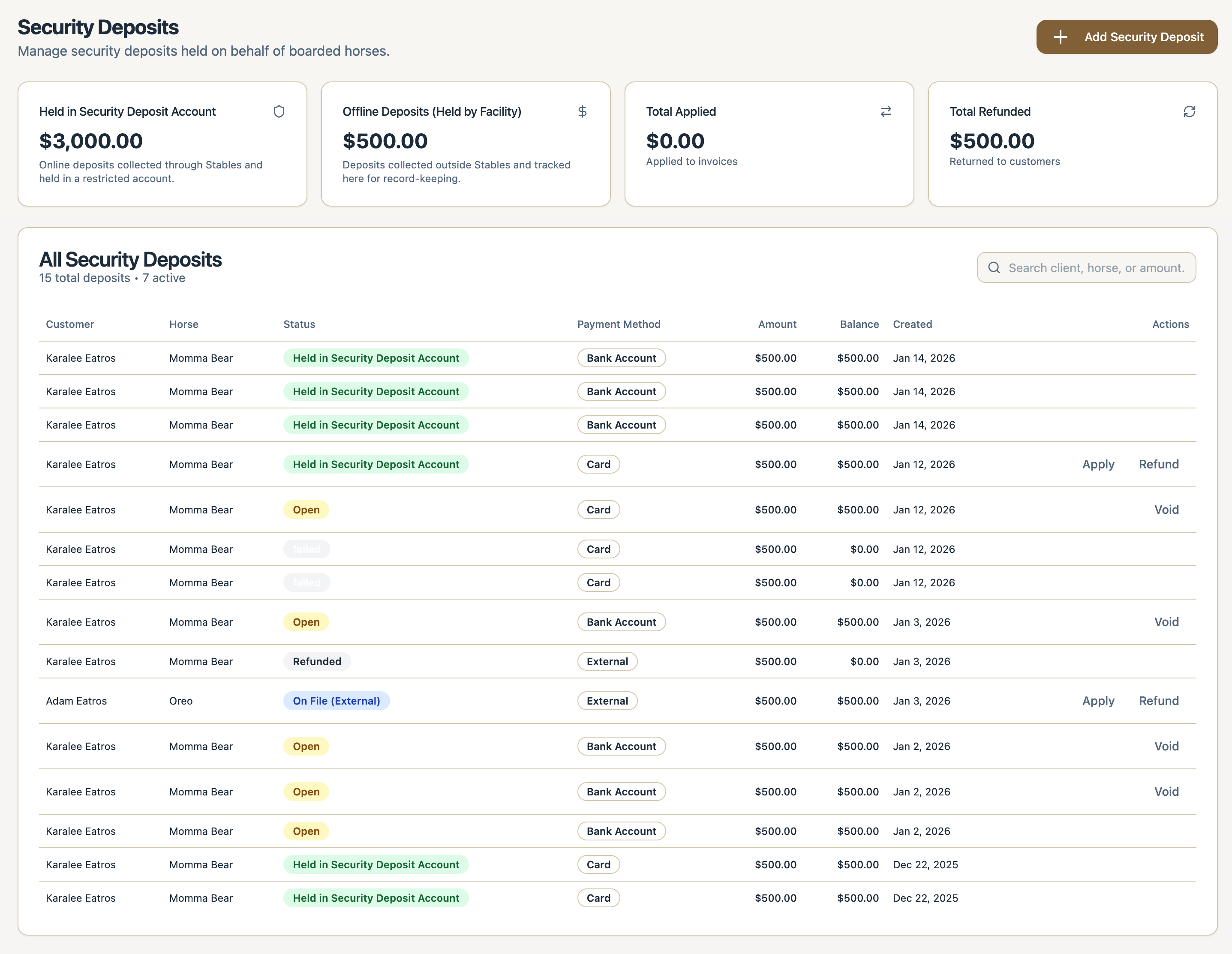
Key Features of Boarding Barn Security Deposit Tracking Software
Not every barn management platform handles deposits with equal care. Some treat deposits as just another payment type. Others ignore the accounting distinction entirely. The table below covers the features that matter most and why each one is relevant to how boarding facilities actually operate.
Key Features of Boarding Barn Security Deposit Tracking Software
| Feature | Why It Matters for Boarding Barns |
|---|---|
| Separate deposit ledger | Keeps liability funds out of operating revenue; prevents misclassification |
| Automated deposit recording | Eliminates manual entry errors and ensures every payment is time-stamped |
| Individual boarder accounts | Each horse owner sees only their own balance; no commingling risk |
| Documented deduction workflow | Creates a defensible paper trail before any refund is issued |
| Automated refund processing | Refunds tie back to the original transaction; no reconciliation gaps |
| Owner-facing deposit portal | Transparency reduces friction and pre-empts disputes at departure |
| Reporting and analytics | Identifies deposit trends, overdue refunds, and outstanding liabilities |
| Automated notifications | Reminds boarders of deposit requirements and return timelines |
| Full audit trail | Every action time-stamped and attributed; essential for dispute defense |
| Mobile access | Barn managers can review and process deposits from anywhere |
| Integration with billing | Deposits and board fees live in one system; no double entry |
| Stripe or payment-layer integration | Refunds initiate from within the platform; clean transaction record |
Key Features of Boarding Barn Security Deposit Tracking Software
How to Choose the Right Security Deposit Tracking Software for Your Barn
With a clear picture of what good deposit tracking looks like, here is a practical framework for evaluating your options.
1. Assess Your Current Process
Before evaluating software, map out exactly how you handle deposits today. Where do you record them? Where do funds sit? How do you process refunds? Identifying specific gaps in your current process makes it much easier to know what features you actually need versus what sounds good in a demo.
2. Look for Equine-Specific Platforms
Generic property management or accounting software can be adapted for boarding barns, but it rarely handles equine-specific workflows out of the box. Platforms designed for boarding facilities will have the right terminology, the right account structures, and features that reflect how horse owners and barn managers actually work together.
3. Request a Demo and Run It Through Real Scenarios
Most platforms offer a free demo or trial. Do not just watch a guided tour. Bring a real scenario from your barn and run it through the software. Can you collect a deposit, document a deduction, and issue a partial refund with an itemized statement? If the software cannot handle your actual workflow, it will not serve you well.
4. Verify Integration with Your Existing Systems
Deposit tracking that exists in a silo creates reconciliation work. The platform you choose should integrate with your billing system, your general ledger or accounting software, and your payment processor. The fewer manual handoffs between systems, the smaller the chance of a recording error.
5. Evaluate the Payment Layer
Platforms with embedded payments, meaning the payment processing is built into the same system rather than handled by a separate tool, have a significant advantage for deposit management. Refunds initiated within the platform are automatically tied to the original deposit transaction, creating a clean record without manual reconciliation.
6. Check Customer Support Quality
Deposit disputes often surface at inconvenient moments. Make sure the platform you choose offers reliable support through channels that work for you, whether that is chat, phone, or email. Read reviews from other boarding barn owners specifically about their support experiences.
7. Evaluate Total Cost and Return on Investment
Price matters, but the relevant question is not what the software costs. It is what a single deposit dispute, tax correction, or regulatory penalty would cost you. For most boarding facilities, the risk avoidance value of proper deposit tracking far exceeds the software cost.
How Stables.co Handles Security Deposit Tracking
Stables.co was built specifically for boarding facilities that need more than a generic payment button. Deposits are treated as a separate account type from the moment of collection. The platform maintains a real-time view of outstanding deposit liabilities, guides barn managers through a structured refund workflow, and processes refunds through embedded Stripe payments so every transaction is traceable from collection to final disposition.
Here is how Stables.co compares to a spreadsheet-based or manual approach across the capabilities that matter most:
Security Deposit Tracking - Manual vs Automated
| Capability | Spreadsheet / Manual | Stables.co |
|---|---|---|
| Separate deposit ledger | No | Yes |
| Automated deposit recording | No | Yes |
| Deduction documentation | No | Yes |
| Owner-facing deposit view | No | Yes |
| Full audit trail | No | Yes |
| Embedded payment refunds | No | Yes |
| Automated boarder notifications | No | Yes |
| Integrated billing and deposits | No | Yes |
Security Deposit Tracking - Manual vs Automated
For a full comparison of eight barn management platforms, including how each handles billing, deposits, and payment processing, see our complete barn management software comparison guide.
Frequently Asked Questions
Do boarding barns have to keep security deposits in a separate bank account?
Requirements vary by state and by individual boarding agreement terms. Even where it is not legally required, maintaining a separate deposit ledger through your management software reduces accounting risk, keeps your financial statements accurate, and makes refund processing far cleaner than commingled funds allow.
How long does a boarding barn have to return a security deposit?
There is no universal timeframe for equine boarding facilities. Your boarding agreement should specify a window, typically between 14 and 30 days after departure. Whatever timeframe you commit to in writing, your software should help you track the deadline and ensure the refund processes on time.
What deductions can a boarding barn make from a security deposit?
Allowable deductions depend on what your boarding agreement specifies before the dispute arises. Common examples include stall damage beyond normal wear and tear, unpaid board or other outstanding balances, and failure to provide the required departure notice. Every deduction should be documented in writing with supporting evidence at the time it is applied.
What happens if a boarding barn misclassifies a security deposit as revenue?
Misclassifying a deposit as revenue overstates your taxable income and creates a balance-sheet liability that is not reflected in your financials. If you cannot return deposits on request because the funds have been spent, you also face legal exposure. Proper security deposit tracking software prevents this by treating deposits as a separate liability from collection through final refund.
Can security deposit tracking software help prevent disputes with horse owners?
Yes, and significantly. Most deposit disputes arise from a lack of documentation rather than genuine disagreements about facts. When you have a time-stamped record of the deposit amount, the terms under which it was collected, each deduction with supporting notes, and the refund transaction itself, you have a defensible position even if a dispute escalates beyond a simple conversation.
What is the difference between deposit tracking software and general accounting software?
General accounting software can record deposits as a liability line item, but it does not provide the workflow support that boarding facilities need: individual boarder accounts, move-in and move-out documentation integration, itemized deduction processing, automated boarder notifications, or refund initiation through an embedded payment layer. Purpose-built barn management software handles the entire deposit lifecycle, not just the accounting entry.
Ready to handle deposits the right way?
Start your free account at Stables.co and see how deposit tracking fits into the full platform.
Stables.co gives boarding facilities a purpose-built deposit ledger, structured refund workflows, automated boarder notifications, and Stripe-embedded payments so every dollar is accounted for from day one. No spreadsheets. No manual reconciliation. No disputes you cannot defend.