

Horse Trainer Billing: Monthly Training Fees, Show Expenses and Getting Paid on Time
Horse trainer billing breaks down when training fees, show expenses, and extra services live in different places and the invoice comes weeks later. This guide shows how trainers set monthly fees, bill show costs, and collect on time. It is written for equine coaches and trainers who run a client list.
By Stables Team
How Much Do Horse Trainers Charge?
When an owner asks "how much do horse trainers charge?", the honest answer is a range that depends on the program. A fee reflects the trainer's skill, the barn's costs, the discipline, and what the month actually includes. That is why a number pulled from a forum rarely fits your business. The drivers behind the number matter more.
Your own fee schedule is the number that counts. Build it from your costs, your time, and what clients in your market pay. Then write it down so every client sees the same terms. A fee that lives only in your head becomes a different fee for every client.
Six factors move a trainer's fee the most:
| What moves the fee | How it changes what you bill |
|---|---|
| Discipline | Hunter/jumper, dressage, reining, and western programs differ in coaching time, tack, and show costs |
| Program level | Full training, partial training, and training rides each cover a different amount of work |
| The horse | A green Thoroughbred off the track or a young prospect takes more time than a finished show horse |
| Location | Land, labor, and feed costs and client demand vary by market |
| Inclusions | Lessons, turnout, grooming, and show-day coaching either sit inside the fee or get billed on their own |
| Trainer record | Experience, show results, and waitlist demand support a higher fee |
What are typical horse training fees, and what do they include?
Horse training fees usually take one of four shapes. A monthly fee covers a defined program. A per-ride fee covers part-time or short-term work. A per-lesson or hourly fee covers coaching. Per-event fees cover shows and clinics. Many trainers combine them, using a monthly fee as the base and billing everything else separately.
What the fee includes is where most billing disputes begin. List the haves of each package in plain terms:
- How many rides a week the horse gets, and who rides
- Whether lessons for the owner are included
- Turnout, blanketing, and grooming
- Whether you schedule the farrier and vet, and whether that time is billed
- Show prep, tack-up, and show-day coaching
- Whether boarding is part of the fee or billed on its own line
A written list of haves and have-nots spares you the "I thought that was included" conversation. Boarding deserves its own line when the horse lives at your barn, because you carry that cost whether or not the horse is ridden that week. Equestrians who compete usually appreciate the clarity, since they budget by line item.
How much does horse training cost per month?
The monthly total an owner pays is the training fee, plus board, plus add-ons. Add-ons include farrier visits, vaccinations, vet calls, supplements, lessons, and show costs. Training and board stay steady from month to month. Add-ons move with the horse.
A typical statement for an equine in full training has four or five lines: training, board, farrier, vet or vaccinations, and any lessons or show charges. When owners see one lump total, they assume something is wrong. When they see each line, they can follow the money.
Because markets, disciplines, and programs vary so widely, the right monthly figure for your barn comes from your own costs and client base, not from an average.
Horse training cost per hour: do trainers charge hourly?
Some do. Hourly or per-session pricing is common for lessons, evaluations, clinics, and one-off coaching, where the client buys a set block of your time. Full training is harder to price by the hour, because a month includes work nobody times: groundwork, cooling out, talking with the owner, and coordinating the farrier and vet.
If you charge a flat monthly fee, check it against the clock. Divide the month's fee by the hours you actually spent on that horse, including unbilled calls and texts. If that rate falls below what you earn teaching lessons, the fee needs to rise or the package needs to shrink.
How much does it cost to have a horse trained?
The total cost to have a horse trained is the monthly fee times the length of the program, plus extras. Program length depends on the goal. A Thoroughbred coming off the track needs a different timeline than a young prospect being started under saddle or a made horse being tuned for the show ring.
Owners should receive a written estimate that names the expected number of months, the monthly lines, and the extras that could appear. Trainers who give that estimate up front have fewer arguments about surprise costs later.
How Do You Set Up Horse Trainer Billing for Monthly Training?
Good horse trainer billing starts with a few decisions you make once and repeat every month. Here is a quick overview of the basics:
- Define the program in writing. Name the rides per week, included lessons, and what counts as an add-on.
- Bill monthly training in advance, on the same date each month. You pay for feed, labor, and the farrier before the month ends, so collecting at the start protects your cash flow.
- Set a due date and accepted payment methods in the agreement.
- Separate recurring charges from one-time charges, such as a clinic fee or a vaccination you paid for up front.
- Log services when they happen, not at month end. A lesson you remember on the 30th is one you forget on the 31st.
- Send an itemized invoice that matches the agreement line for line.
- Check balances weekly instead of waiting for the books to close.
This routine also feeds your bookkeeping. Each invoice becomes a clean entry that you or your bookkeeper can record in QuickBooks, and your financials show which clients carry balances. Messy invoicing makes accounting slow, because someone has to rebuild what happened from texts and memory. A trainer who manages a dozen clients feels that pain every month.
Do horse trainers bill monthly or per ride?
Both exist. Monthly billing in advance suits ongoing training programs, because the client buys a defined amount of work. Per-ride billing suits part-time arrangements, short-term help, or owners who only need a horse worked a few days. Lessons are usually billed per lesson or as a package. Many trainers mix the models, with a monthly base for training and board plus per-event charges. Whatever model you choose, the invoice should show the same structure the agreement describes.
Do horse trainers require a deposit?
Some do. Common uses are a deposit to hold a spot in the program, the first month paid in advance, and a deposit toward show entries before the trainer pays the show office. A deposit also gives both sides a clear starting point for the agreement. Say in writing whether the deposit is refundable, what it applies to, and what happens if the horse leaves early. Expectations differ by state and by barn, so have a local attorney review your terms.
How Do Horse Trainers Bill Show Expenses?
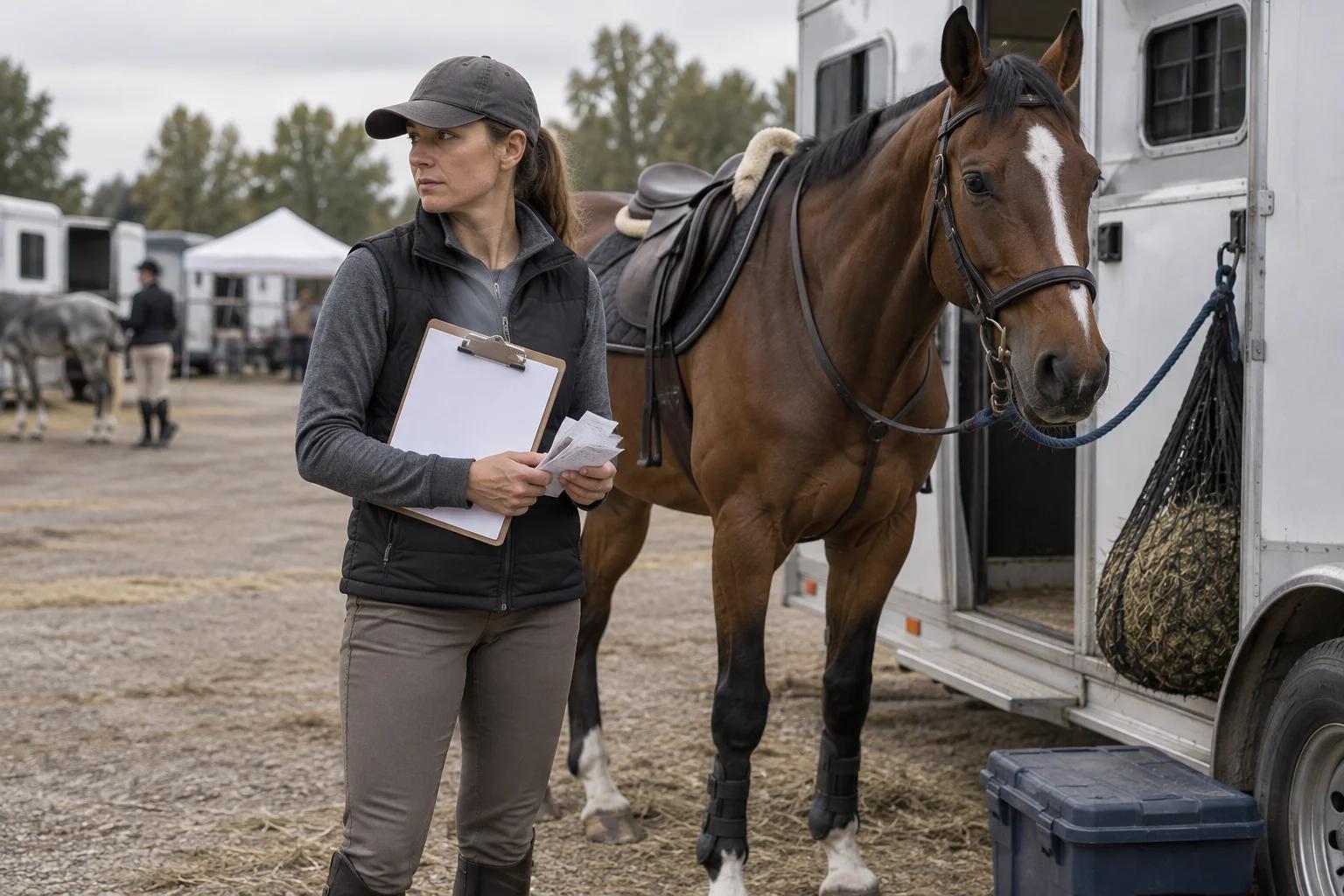
Show weekends are where trainers lose money most often. The trainer pays stall fees, class entries, and shavings on one card days before any client is billed. The final bill gets assembled from receipts a week later, if it gets assembled at all. Show expense billing is the hardest part of horse trainer billing for this reason.
Picture a trainer taking three horses to a weekend show. Stall fees, class entries, a hauling trip, and one shared hay order all land on the trainer's card. Each cost belongs to a specific horse, but the receipts do not say which one. A farrier visit the day before the trip never makes it onto anyone's invoice. By Monday, the trainer is absorbing charges nobody remembers.
!Trainer reviewing a show weekend expense list beside a horse trailer at a show grounds
Show costs fall into a handful of groups, and each bills a little differently:
- Class entries and office fees: bill at cost, with the receipt.
- Stalls, bedding, and feed at the show: split by horse and by day.
- Hauling: a flat trip fee or mileage, whichever your agreement states.
- Show-day coaching and groom time: a per-day rate.
- Farrier, vet, vaccinations, and health papers required for entry.
- Trainer travel: hotel, fuel, and meals, with a clear rule on whether clients share them.
Three habits keep the paperwork clean around a show:
- Send a pre-show estimate and collect a deposit toward entries.
- Record each expense against a horse the day it happens.
- Invoice within a set number of days after the show, with the itemization attached.
Decide how you pass costs through: at cost with receipts, with a coordination fee, or as a flat show fee. Any of the three works if the agreement states it before the show. Owners accept costs they expected, and they argue about surprises. The expense detail your bookkeeping needs to record the show is the same detail the client needs to see, so one set of entries serves both.
How Do Horse Trainers Get Paid on Time?
Trainers get paid late mostly because of process, not because clients are difficult. The invoice goes out weeks after the work. The charges arrive in one lump. Paying means mailing a check or hunting for a Venmo handle. Each gap gives an owner a reasonable-sounding reason to wait. Meanwhile your feed, labor, farrier, and hauling bills come due on your own card, and you are chasing a client you also coach.
Pay-on-time basics look like this:
- Invoice on a fixed schedule. Monthly training goes out in advance, and show expenses go out within days of the event.
- One itemized invoice per client, with every line tied to a date and a horse.
- Easy payment. A payment link, online card or bank payment, and autopay for the recurring training fee where available.
- Visibility. The owner can see the invoice, the balance, and the history without asking.
- The same follow-up every time. Send a reminder email before the due date and one right after it.
Reliable invoicing also makes your financials readable. When invoices go out on schedule, your accounting reflects what clients owe, and you can see cash coming in. Many trainers keep their books in QuickBooks. Whatever tool you use, bookkeeping works best when every charge starts as a dated entry.
How software connects training work to the invoice
The Stables is a care-to-cash platform, and for equine professionals it connects the work you do to the invoice and the payment. Trainers get client and horse management, appointment scheduling, booking requests, service history, invoicing workflows, and online payment collection in one workflow. Payment status tracking shows who has paid. Owners see invoices and payments through a free web account, so nobody downloads an app.
The Stables has no monthly software fee to start, and transaction-based pricing means the cost follows the payments you actually collect. Providers can invoice their own clients and collect online card and ACH payments, and a transaction fee applies only when a payment is processed through Stables. You can start free, set up a few clients, and see how pricing works before moving the rest.
What Can a Horse Trainer Do When a Client Pays Late?
Start with the invoice, then the conversation.
- Check your own process first. Was the invoice sent, itemized, and easy to pay? Fix that before anything else.
- Contact the client quickly. A short, friendly message with the invoice, the balance, and a payment link beats silence. Emails and texts both work, and both leave a written record.
- Offer a path. A client in a tight month may accept a split payment, as long as the new dates go in writing.
- Apply the late fee only if your agreement has one, and apply it the same way for every client.
- Pause extras. Hold new show entries and add-ons until the account is current, and say so in the agreement ahead of time.
- Escalate in writing. A formal notice that cites the agreement comes next. Some states have laws that let a trainer or boarding barn claim a lien for unpaid care or board. Rules vary, so ask a local attorney before holding a horse or taking legal steps.
Keep the service history. Dated rides, lessons, invoices, and the signed agreement are your evidence if a dispute continues. Strong records also make the conversation calmer, because both sides can look at the same facts. That is the ins and outs of collecting without damaging the relationship.
Frequently Asked Questions
How much should a horse trainer charge?
A trainer should charge enough to cover barn costs, labor, and their own time, with room for profit, while staying within what clients in that market and discipline will pay. Start with your monthly costs and the hours each program takes, check the effective hourly rate, and put the fee schedule in writing. Review it once a year as feed and labor costs change.
Is there free horse trainer billing software?
The Stables is free to start for service providers at $0/month, with transaction fees when payments are processed through it. It runs in a web browser, so neither trainers nor clients download an app. It covers client and horse records, appointment scheduling, invoicing workflows, and online payment collection. A spreadsheet also costs nothing, but you build every invoice and track every balance by hand.
Should trainers mark up show expenses?
That is a business choice. Some trainers pass expenses through at cost with receipts, some add a coordination or administrative fee, and some charge a flat show fee. Any of these can work if the agreement states the method before the show and the invoice itemizes every charge. Surprises, more than markups, tend to start the disputes.
What should a horse training agreement include?
A horse training agreement should state what the program and fee cover, the monthly fee and board, billing and due dates, accepted payment methods, deposit terms, late fees, the show expense policy, how add-ons are charged, and the notice required to end the program. Have a local attorney review the final document, because legal requirements vary by state.
Get Paid for the Training You Already Deliver
Your rides, lessons, and show costs should flow into one invoice instead of a pile of receipts and texts. Start free and see how The Stables helps trainers collect faster, built for equine service providers.