
Barn Care Logs That Survive a Shift Change: Handoffs Without Missed Charges
A horse care log fails the moment a shift changes and the evening feed change lives only in someone's head. A written log fixes that. When the log feeds horse facility software, every blanket swap, medication and extra hay flake reaches the invoice instead of disappearing.
By Stables Team
What Is a Horse Care Log and What Should It Include?
A horse care log is a dated record, kept for each horse, of the care it received and who gave it. It sits behind your longer-term horse care records and treatment histories. For a boarding barn, it also shows which tasks cost you time or product, and those are the tasks you can bill.
A useful horse care log covers six areas for every horse:
- Feed and hay: amounts, changes, supplements
- Turnout and stall: times out and in, restrictions
- Blanketing and grooming: which blanket, any extra service
- Medications and treatments: product, dose, time, who gave it
- Horse health events: lameness, injuries, colic signs, vet calls
- Scheduled care: vaccinations, deworming, hoof care, farrier trims, dentist and veterinary visits
Every entry needs a date, time, horse name, what was done, and the initials of whoever did it.
What Should a Horse Care Log Template Include?
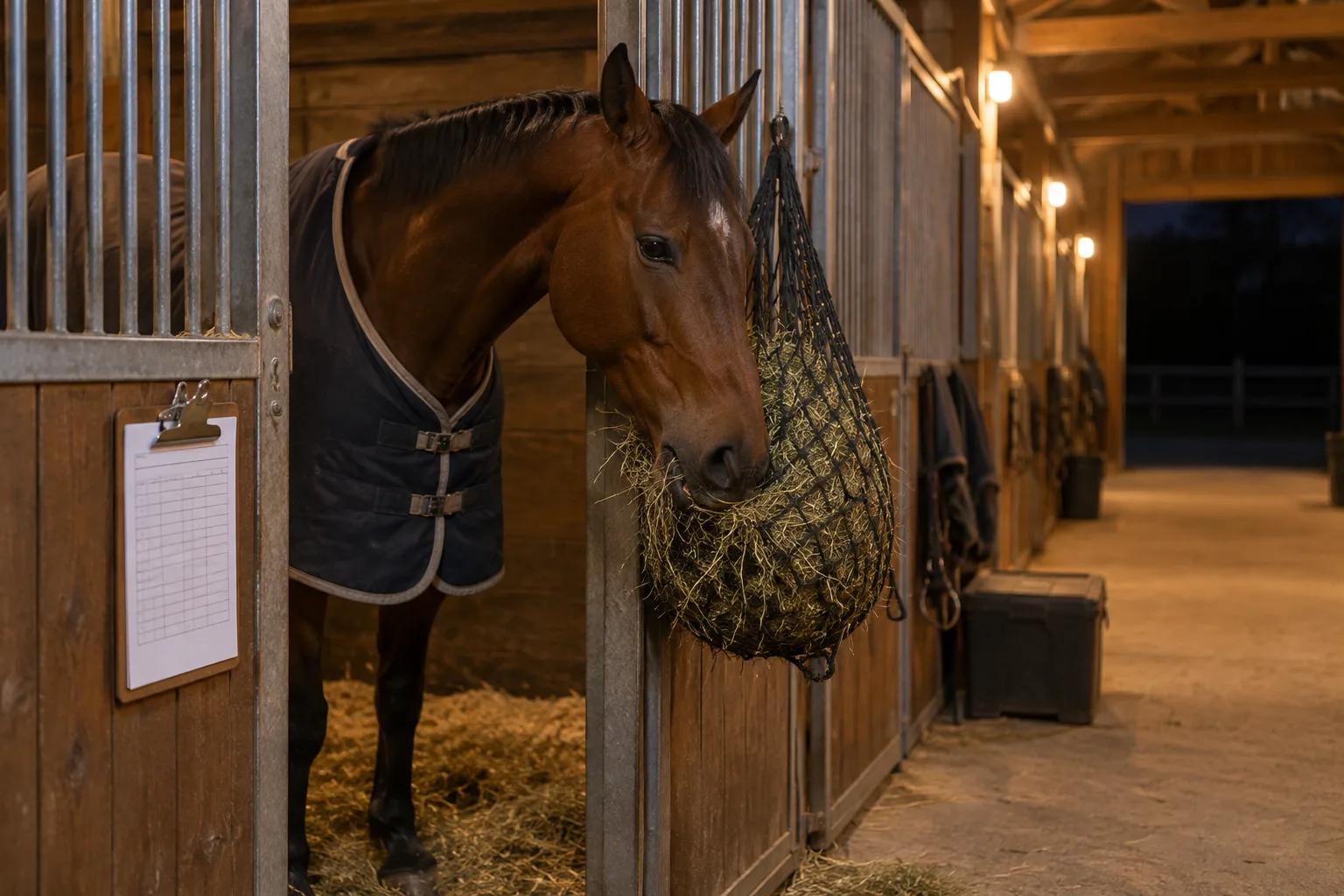
A horse care log template, printable or on a screen, needs one row per task: date, time, horse, task, amount or dose, initials, and a "billable" box. The billable box connects the log to your invoice. Add one horse health record page per horse for vaccinations, Coggins tests (the blood test for equine infectious anemia), deworming dates, and hoof care histories.
How Do You Keep a Barn Log That Works Across Every Shift?
A barn log works when every shift writes to the same place, in the same format. Use these five steps.
- Keep one log in one place. A notebook plus a text thread means someone reads the wrong one.
- Write the entry when the task is done. End-of-shift notes get skipped on busy nights, and skipped entries become unbilled work.
- Use the same words every time. "Blanket change, heavy to medium" beats "swapped rug."
- Mark billable tasks as you go.
- Initial every entry. Initials give staff accountability and tell the next shift whom to ask.
What Horse Care Records Should Staff Write Down at Each Feeding, Turnout and Treatment?
- Feeding: any change in feed, hay or supplements, and any horse that left food.
- Turnout: paddock, out and in times, and any injury or odd behavior.
- Treatment: the medication, dose, time, the vet's instruction, and how the horse tolerated it.
These horse care records also help in emergencies. When a vet asks what a colicky horse ate and when, a dated log gives clear timelines in seconds.
How Do You Hand Off a Barn Shift Without Missing a Charge?
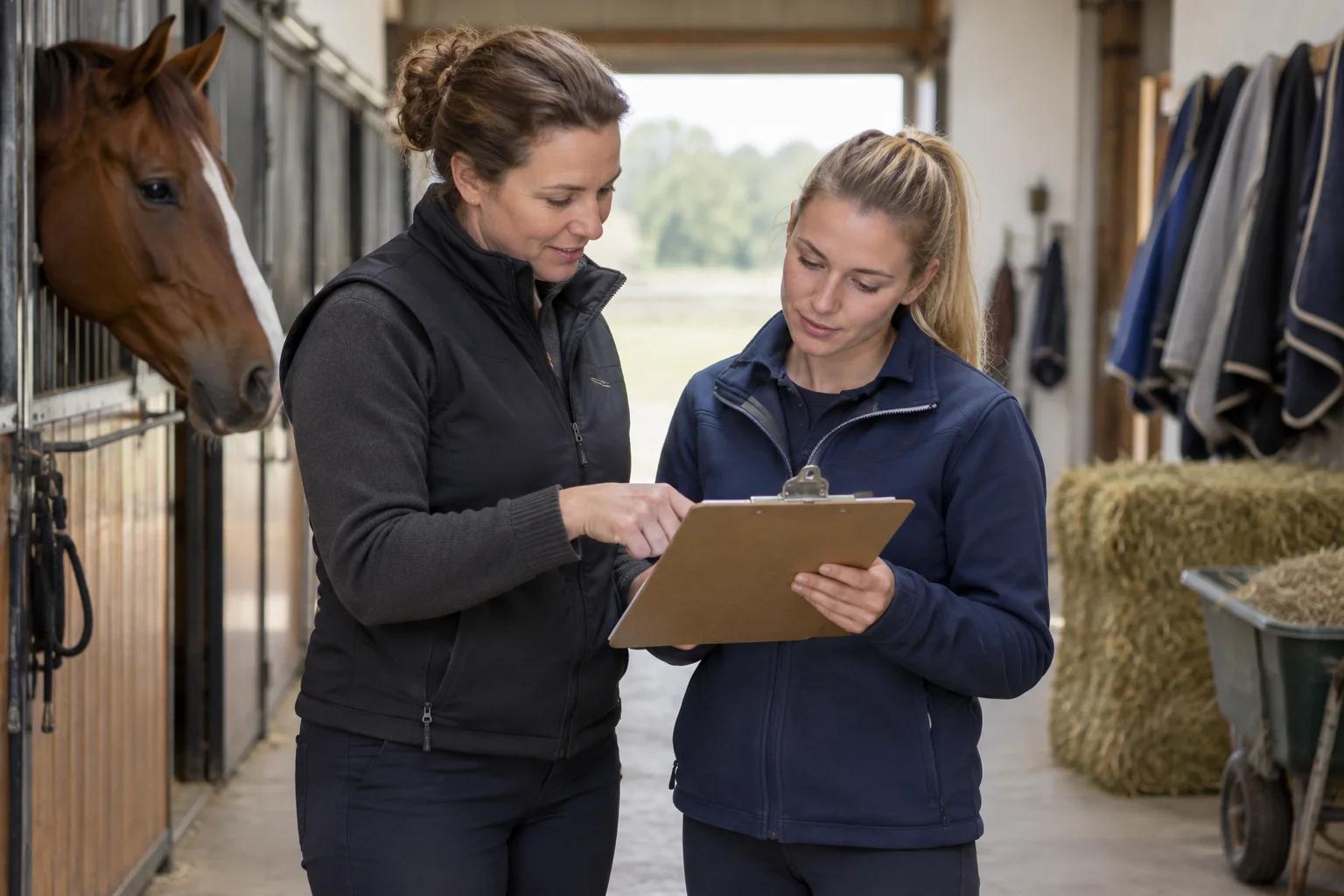
Walk the log with the incoming person for five minutes before the outgoing person leaves. Cover four things:
- Open items: medications due, a vet or farrier arriving, a horse on stall rest
- Changes since last shift: new feed, new hay amounts, owner requests
- Billable entries not yet marked
- Health flags: lameness, swelling, a horse off its feed
Here is how a charge goes missing. An owner texts the manager that her mare needs a second flake of hay at night. The morning person hears it. The evening person does not. One shift gives the extra hay, nobody writes it down, and nothing reaches the invoice. Across ten horses for a month, that is revenue leakage: money you earned and never collected.
To put a number on what slips through, run your own figures through the barn profit calculator.
!Barn manager and stall attendant reviewing a horse care log together at shift change
Is a Paper or Digital Horse Care Log Better for a Boarding Barn?
Paper works for a small barn with one shift. It breaks when several people share the workload. Here is how the main options compare.
| Option | Works well for | Where it breaks |
|---|---|---|
| Free printable template on a clipboard | One barn, one shift, a few horses | Pages get lost; billing means retyping |
| Physical book or journal | Long-term notes on one horse | Hard to search, one copy in one place |
| Spreadsheet | Sorting by horse and date | Needs a maintainer; no link to payment |
| Digital software | Many staff, many horses, boarding billing | Staff need a working device and web access |
How Do You Turn a Horse Care Log Into Accurate Boarder Billing?
Review billable entries per horse on a fixed day, price each against your rate sheet, and add them to the invoice with the recurring board. If that review happens in QuickBooks or a spreadsheet days later, you are reconstructing care instead of reading it.
Can a Horse Care Log Be Used to Bill Boarders for Extra Services?
Yes, with one condition: your boarding agreement or price list must name the service and its fee. The agreement gives you the right to charge, and the log proves the work happened. Typical extras include twice-daily medication, blanket changes and grooming. If an owner questions a charge, you show the dated, initialed entry.
Stables is built around this connection. As a care-to-cash operating system for boarding facilities, Stables ties daily care, stall management, scheduling, recurring board billing and add-on charge capture to invoices, online card and ACH payments, and autopay. Boarders get an email link to a web portal they can save to their phone's home screen, so there is no app to download. It is free to start, no credit card, with a transaction fee only when a payment is processed through Stables.
What Is the Difference Between a Barn Log and Horse Care Records?
A barn log is the shift-by-shift record of what happened today. Horse care records are the permanent file for each horse: vaccination histories, Coggins tests, deworming schedules, farrier and dentist visits, vet records, treatments and lameness notes. The log feeds the records. Boarding agreements and insurers often ask for proof of vaccinations and a current negative Coggins test, so compliance depends on a current file.
How Long Should You Keep Horse Care Records?
No single rule fits every barn. Keep health histories while the horse boards with you, then for a period your attorney and insurer set. The IRS generally advises keeping records behind a tax return for at least three years, and your accountant may want longer.
Common Mistakes and How to Tell Your Log Is Working
The usual mistakes are writing at the end of the shift, skipping initials, and leaving the billable box blank. For a spot check, pick one horse, rebuild last week from the log alone, then confirm each billable entry reached an invoice.
If a digital log will not load on shift, the cause is usually the device. First, enable JavaScript in your browser settings, since web tools rely on it. Next, a browser extension such as an ad blocker can stop scripts from running. Open the extensions browser menu, temporarily disable your browser extensions, and reload. The verification challenges Cloudflare shows before some pages load can also stall behind blockers or an outdated operating system. If barn Wi-Fi is the problem, check the network settings, or ask the network administrator who set up the router to allow the site.
Connect Your Care Log to Collected Revenue
Once your log is reliable, the last step is making sure it reaches the invoice. See how Stables connects care to billing in our barn management software.